Showing posts with label Linschoten. Show all posts

Tuesday, 23 August 2011

St. Matthew Island and two St. Helenas

1519, St. Helena, Atlas Nautique du Monde, Biblioteheque National de France
The genesis of this post was the page in the Maps and Views section of Barry Weaver’s St Helena Virtual Library and Archive illustrated by a part of Jansson’s 1646 map “Mar di Æthiopia Vulgo Oceanus Æthiopicus which describes the appearance, on early maps, of the mythical islands of New St. Helena and St. Matthew.  It can be accessed here: http://www.bweaver.nom.sh/maps/jansson.htm 

As he suggests: “the mislocation of islands was inevitable given the large navigational errors common in the sixteenth and seventeenth centuries, but once added to sea charts such islands proved extremely resilient, even in spite of a lack of any further evidence to support their existence.”

1547,Vallard Atlas, St. Matthew and St. Helena, South Orientation
Click on images to enlarge

1554, Gastaldi, St. Matthew and St. Helena, South Orientation

1570, Ortelius, St. Matthew

1596, Linschoten, St. Matthew and St. Helena

In 1656 Peter Mundy refers to St Matthew Island when writing about Ascension:
Soe now againe concerning the Ascention birds allsoe, thatt can neither fly nor swymme.  The iland beeing aboutt 300 leagues from the coast of Guinnea and 160 leagues from the iland of St Matheo, the nearest land to it, the question is, how they shold bee generated, whither created there from the beginning, or thatt the earth produceth them of its owne accord, as mice, serpentts, flies, wormes, etts, insects, or whither the nature of the earth and climate have alltred the shape and nature of some other foule into this, I leave it to the learned to dispute of.

By 1634, in addition to St. Matthew, a second St. Helena started to appear on Maps and Charts.

1634, Guerard, Carte Universelle Hydrographique, Biblioteque National de France


1664, Du Val, I Ste Helene la nouvelle

1689, Coronelli

Though admitting that the New Isle of St Helena was thought by many to be legendary, St. Matthew is described as having a small lake of good fresh water and that it was discovered in 1526.

1706, Schenck

1717, Nicholas de Fer
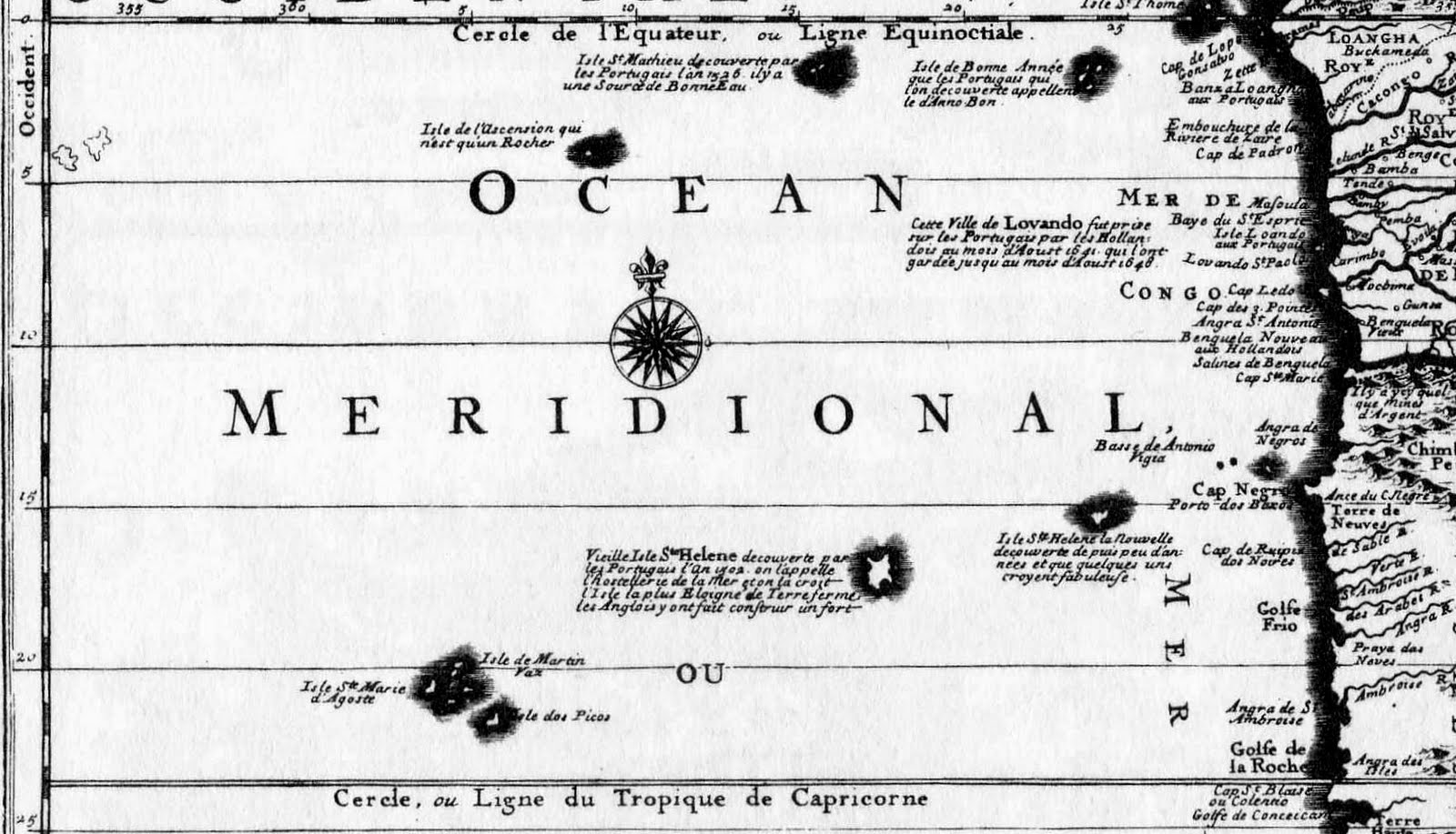
1722, Nicholas de Fer
De Fer repeats the same information about St. Matthew as the 1689 Coronelli map

On his second voyage Cook sailed on “Resolution” from St. Helena on the 21st May 1775.  On the 31st May he left Ascension and “steered to the northward with a fine gale at S. E. by E.”  “I had a great desire to visit the island of St. Matthew, to settle its situation; but as I found the wind would not let me fetch it, I steered for the island of Fernando de Noronha, on the coast of Brazil in order to determine its longitude, as I could not find this had yet been done.  Carrying on board Kendall’s KI chronometer "Resolution" was the first survey ship to carry such an instrument and had St Matthew existed would have been charted with some accuracy.

Purdy's 1814 "Tables of the observed positions of the principal points and places on the coasts of the Atlantic, Ethiopic and Indian Oceans" casts doubt on the existence of St. Matthew:

"We are told, by several historic geographers, that St. Matthew is an island discovered by the Portuguese, in the year 1516, by whom it was afterwards planted; and that vessels frequently stop here some days to take in refreshments.  Guthrie says (Edition of 1783) the Portuguese " planted and kept possession of it for some time; but afterwards deserted it.  This island now remains uninhabited, having little to invite other nations to settle there, except a small lake of fresh water."

"We think it not improbable that this island, like the Land of Bus, in the Northern Ocean, may have entirely disappeared.  Archihald Dalzel, Governor of Cape Coast Castle, sought for it, without success, in 1799 and 1802, and it appears almost certain, from his routes, between 1 and 2 degrees South, longitude, 3 to 10° W. that it does not exist within this space.  "Mr. Dalzel has made many enquiries among the Portuguese about this island, without meeting with any person who pretended to have seen it, except one, who gave him a rough draught of it, which was laughed at by the other Brasilians, who said he must have been deceived by a cloud."

It did, however, still appear on the 1828 German map below.


Sunday, 24 April 2011

The Portuguese Church, 1571

“Where the English settle they first build a Punch house, the Dutch a Fort and the Portuguese a Church.” Janisch 1885 April 7 1711, Jackson 1903 p.181, Gosse 1938 p.135, and Cannan 1992 p. 23.

On the 21st May 1502 Joao da Nova returning to Europe from India discovered St. Helena.  Gosse relates that “according to several early legends a large carrack, one of the fleet, was either wrecked or else became so unseaworthy that the Portuguese broke her up and drew on shore her weather-beaten sides and all the armoury and tackling, building with the timber a chappell in this valley, from thence is called Chappell Valley”
By the time Thomas Cavendish set foot on St Helena on the 9th June 1588, the early wooden church had been replaced by one of stone.

Linschoten's drawing of the Stone Church and The Santa Cruz flying the Portuguese Standard, May 1589
About two or three of the clocke in the afternoone wee went on shore, where wee found a marveilous faire & pleasant valley, wherein divers handsome buildings and houses were set up, and especially one which was a Church, which was tyled & whited on the outside very faire, and made with a porch, and within the Church at the upper end was set an altar, whereon stood a very large table set in a frame having in it the picture of our Saviour Christ upon the Crosse and the image of our Lady praying, with divers other histories curiously painted in the same. The sides of the Church were all hanged with stained clothes having many devises drawen in them.
There are two houses adjoyning to the Church, on each side one, which serve for kitchins to dresse meate in, with necessary roomes and houses of office: the coverings of the said houses are made flat, whereon is planted a very faire vine, and through both the saide houses runneth a very good and holsome streame of fresh water.
There is also right over against the saide Church a faire causey made up with stones reaching unto a valley by the seaside, in which valley is planted a garden, wherein grow great store of pompions and melons : And upon the saide causey is a frame erected whereon hange two bells wherewith they ring to Masse ; and hard unto it is a Crosse set up, which is squared, framed and made very artificially of free stone, whereon is carved in cyphers what time it was builded, which was in the yeere of our Lord 1571.
The Portuguese fleet had left the island, for Europe, twenty days before Cavendish’s arrival.
We found in the houses at our comming 3. slaves which were Negros, & one which was borne in the yland of Java, which tolde us that the East Indian fleete, which were in number 5. sailes, the least whereof were in burthen 8. or 900. tunnes, all laden with spices and Calicut cloth, with store of treasure and very rich stones and pearles, were gone from the saide yland of S. Helena but 20, dayes before we came thither.

The Stone Church and Linschoten's Fleet, May 1589
Linschoten's drawings were made as the Santa Cruz circled the Island arriving and departing


Jan Huyghen van Linschoten (1563-1611) was a Dutch Protestant merchant, traveller and historian who spent from 1583 to 1588 in the employ of the Portuguese in Goa.  He piloted the Portuguese East India fleet which left Cochin on January 1st 1589 and visited St. Helena in May of that year, eleven months after Cavendish’s visit.
When the ships come thether, everie man maketh his lodging under a tree, setting a Tent about it: for that the trees are there so thicke, that it presently seemeth a little towne or an armie lying in the fielde. Everie man provideth for himself, both flesh, fish, fruite, and woode, for there is enough for them all: and everie one washeth Linnen. There they hold a generall fasting and prayer, with Masse everie daye, which is done with great devotion, with procession, and thankesgiving and other Himnes, thanking God that hee hath preserved them from the danger of the Cape de Bona Speranca, and brought them to that Iland in safetie.

Linschoten also reported on the apparent vandalism by the English:

About foure monthes before our arrivall, there had beene an English ship which came to the Iland of Saint Helena; where they tooke in fresh water and other necessaries, and beate downe the Alter and the Crosse that stoode in the Church, and left behind them a Ketle and a Sword, which the Portingales at our arrival found there, yet could they not conceive or thinke what they might meane.

Gosse tells of other acts of vandalism by Dutch and Portuguese and in 1610 Francois Pyrard discovered on landing the bad state of the chapel, which he had seen in good condition nine years previously. A white marble cross brought from Portugal was broken in pieces, done in revenge, said Pyrard, by the Dutch.

The French traveller Tavernier visited in 1649 and though Gosse cautions that not too much reliance should be placed on his tale continues “There is only a little settlement near the sea where a chapel was once built but this chapel is now half a ruin.
Linschoten's two drawings of St Helena were reproduced as the endpapers in Gosse, part used on the cover of Edward Cannan's "Churches of the South Atlantic Islands" and on the obverse of the St Helena One Pound note, which was replaced by a coin in 1984 and is no longer in circulation.


The same image was also used on the 3p stamp, one of a set of six, issued in 1978 commemorating the 1613 sinking of the "Witte Leeuw" in James Bay.


Captain John Dutton arrived in May 1659 to take possession of the island for The East India Company and the next church to be built would be an Anglican one.

Cannan, 1992, Churches of the South Atlantic Islands 1502-1991 Nelson, ISBN 0 904614 48 4

The Linschoten drawings and more information can be accessed on Barry Weaver's web site St Helena Virtual Library and Archive at: http://www.bweaver.nom.sh/