Showing posts with label St Helena. Show all posts

Tuesday, 3 July 2012

Fletcher Christian, 1785


Previous blog posts have described Captain William Bligh’s two visits to St Helena in 1792 and 1799. It was only on preparing for our recent trip to Pitcairn that I read of the visit to the island, in the spring of 1785, of Fletcher Christian, inextricably linked to Bligh by the events at sunrise on April 28th 1789; The Mutiny on The Bounty.
There is no portrait or drawing extant of Christian that was drawn from life.  This picture is from Richard Hough “Captain Bligh and Mr Christian: The Men and The Mutiny, 1988” and is described as an artist’s impression based on contemporary descriptions.  This description is the one Bligh wrote down for various port authorities after the mutiny:
Fletcher Christian, Master’s mate, age 24 years, 5 feet 9 inches high, blackish or very dark complexion, dark brown hair, strong made; a star tatowed on his left breast, tatowed on his backside; his knees stand a little out, and he may be called rather bow legged.  He is subject to violent perspirations, and particularly in his hands, so that he soils anything he handles.

Born on September 25, 1764 near Cockermouth in Cumberland, in April1783, Fletcher signed on as midshipman on board HMS Eurydice, a 6th rater with 24 9-pound guns commanded by Captain George Courtney.  For almost six months the ship lay at anchor in Spithead but finally, on October 11, Eurydice sailed for India via Madeira and Table Bay.  In Madras, on May 24, 1784, Christian was made acting lieutenant after only one year’s service.  Joining Sir Edward Hughes’ Squadron they sailed to Bombay in November 1784 and then back to England spending three weeks at St. Helena and a night at Ascension.  By June 1785, the Eurydice was back home and Christian was paid off and looking for employment.  His family was on friendly terms with the Bethams, the family of Elizabeth Bligh, and Christian applied for a berth on the merchant ship Britannia, owned by Elizabeth’s uncle Duncan Campbell and commanded by William Bligh.  Bligh took him on board and they sailed together on two voyages to the West Indies.  In August 1787, Bligh’s command of HMAV Bounty was confirmed, Christian was again signed on to sail with him and the rest, as they say, is history.

Tuesday, 17 April 2012

Waterwitch, 1839

Waterwitch Column, Castle Gardens, Jamestown, May 2010

Following Britain’s decision to abolish its slave trade in 1807, in 1808 the Royal Navy established the West Africa Squadron to patrol the South Atlantic in search of illegal slaving operations.  In 1819 a naval station was created in West Africa at a captured slaving port that the British renamed Freetown, later to become the capital of the first British colony in West Africa, Sierra Leone.  Slave ships found to be acting unlawfully were commandeered and, following its establishment in 1840, many were brought to judgment before a Vice Admiralty Court on St Helena.

The Court operated from 1840 to 1865, and during this period a very large number of slaves were taken to the island aboard captured vessels.  The ships were sold or broken up while the human cargoes were fed, clothed and kept, first at Lemon Valley, then at the Liberated African Depot in Rupert’s Valley which operated until 1874.  Most of the slaves who recovered were given passage to the West Indies or British Guiana as labourers; some chose to remain as servants or were used on various public works.

 Rupert's Bay, Hospital of the Liberated Slaves Depot, March 2010

The absolute number is unclear, but it is estimated that over 26,000 “liberated” Africans were received during this period.  About one-third of those landed did not survive, and were buried in large institutional graveyards and approximately 5,000 are thought to lie in Rupert’s Valley.

Simmonds Colonial Magazine and Foreign Miscellany recorded the first arrivals:
“The first slaves, captured on the western coast of Africa, and conveyed to the Island of St. Helena were taken there by the brig Waterwitch on 9th June 1840 and amounted to only four.  On 6th July the slave vessel Andorinha captured by the brig Brisk arrived with one slave on board and on the 25th two more were added, further increased by fifteen on the 24th October.  All these Africans, amounting to only 22, having been liberated by the judgement of the Vice-Admiralty Court were easily disposed of as servants to the people of the island, and were consequently of little expense to the Government”.

The Waterwitch Column in the Castle gardens in Jamestown is one of the reminders of this period of St Helena’s history.

The inscription on the East face of the column reads:
“This Column was erected by the Commander, Officers and Crew of her Majesty's Brig Waterwitch to the memory of their shipmates who died while serving on the coast of Africa A.D. 1839-1843.  The greater number died while absent in captured slave vessels.  Their remains were either left in different parts of Africa or given to the sea their graves alike undistinguished.
This Island is selected for the record because three lie buried here and because the deceased as well as their surviving comrades, ever met the warmest welcome from its inhabitants”.

St Helena, Released Slaves, from EL Jackson 1905


Many slaves were lost prior to their ships being boarded and slaves were often jettisoned to avoid the slave ship being captured.  On February 7, 1846, the St. Helena Gazette contained the following:  “We have here a Portuguese schooner, captured by the Waterwitch, for condemnation, with 230 slaves on board. They have the small-pox very bad.  Those that are free from it are landed at Lemon Valley, which place is kept under strict quarantine.  When the Waterwitch first gave chase, the captain endeavoured to get away by lightening the vessel; for which purpose he threw overboard about 130 slaves, having originally on board 350.  He then ran his vessel on shore and made his escape.  The boats of the Waterwitch saved about seventy from drowning, but the greater part of them died afterwards from exhaustion.”

The Gazette for September 13th 1745 reported:
“We learn from our vessels of war, stationed on the western coast of Africa, that from the 1st of April, 1844, to 6th July, 1845, no fewer than 75 slavers have been captured by them, the Americans having, during the same period, captured 1 slaver making a total of 76 captured vessels during a period of fifteen months and six days”.

Indicative of the scale of the operation is a report of the event known as the “Rollers of 1846” which occurred on February
16th and 17th: “Eighteen slave vessels were lying in the roads, some of which had been condemned and sold and were partially broken up.....in seven hours no fewer than thirteen vessels were dashed to atoms within a few yards of the shore, eleven of them were captured slavers.”

St Helena, Bruce, The Rollers of 1846

Although the work of liberating slaves brought money and employment to the Island, it also brought termites among the timbers of a Brazilian slave ship which was broken up and stored in Jamestown.  Eating their way through house timbers and documents they caused the collapse of a number of buildings and considerable economic damage over several decades and the reconstruction had to make use of cast iron, iron rails and termite-proof timbers.  The Market building is a prime example of this; made in cast iron and prefabricated in England in 1865.

St Helena, Jamestown, The Market, May 2010


Friday, 6 April 2012

Lady Penrhyn, 1789

The interlinking of people and places around the British Empire in the late eighteenth century is perfectly illustrated by the First Fleet transport Lady Penrhyn.
On his first voyage from July 1768 to July 1771 Captain Cook on HMS Endeavour was charged by the Royal Society and the British Admiralty to view the transit of Venus from Tahiti and then to look for the Southern Continent.  On board was Joseph Banks, then aged 25, who supplied an estimated £10,000 of his own money to equip the expedition.  Employed by Banks were the Swedish Naturalist Daniel Solander and his fellow scientist, the Finn, Dr. Herman Spöring.  Following the observation of the Transit in June 1769 the voyage then progressed to New Zealand and then became the first European expedition to reach and chart the eastern shores of Australia where, on 29 April 1770, Cook made his first landing.
Initially the name Stingrays Harbour was used by Cook and other journal keepers on his expedition, for the stingrays they caught there.  Cook's log for 6 May 1770 records "The great quantity of these sort of fish found in this place occasioned my giving it the name of Stingrays Harbour".  However, in his journal prepared later from his log, he changed to "The great quantity of plants Mr. Banks and Dr. Solander found in this place occasioned my giving it the name of Botany Bay".  The name Botanist Bay was also sometimes used.
It was Banks’ time in Australia that led to his interest in the British colonisation of that continent and he was to be the greatest proponent of settlement in New South Wales.  In 1779 Banks, by now President of The Royal Society, giving evidence before a committee of the House of Commons had stated that in his opinion the place most eligible for the establishment of a penal colony "was Botany Bay, on the coast of New Holland"
Lady Penrhyn

In 1786 Lady Penrhyn was chartered by the Navy Board as a First Fleet vessel and became one of the eleven ships which left England in 1787 carrying a total of 1,420 people including 775 convicts, sent to establish the first European Colony in Australia in the region which Cook had named New South Wales.
The 333 ton Thames-built transport left Portsmouth on 13 May with 101 female convicts, and arrived at Port Jackson, on 26 January 1788.  She also carried the first horses sent to Australia, which it is thought to have consisted of one stallion, one colt, three mares and two fillies from Cape Town.  As Surgeon responsible for the convicts on board was Arthur Bowes Smythe.  In addition to his official duties he also took a great interest in natural history, collecting specimens and making drawings including the earliest extant illustration by a European of the emu. 
Leaving Port Jackson under Captain Sever, on 5 May 1788 Lady Penrhyn sailed north into the South Pacific.  On board, en route to China, was Lieutenant John Watts who had sailed on Resolution with Cook.  The poor condition of the ship and sickness among her crew compelled her to turn back from the intended voyage to the North West coast of America when she had gone only as far as Tahiti, where the crew recovered and the ship was repaired. When Lady Penrhyn anchored in Matavai Bay in July 1788 they had only three men in one watch, and two in the other besides the mates, and two of these ailing; the rest of the crew were in a truly deplorable state.  The Lady Penrhyn also became the first British ship to visit Tahiti since Cook in August 1777, shortly before Bligh’s arrival in search of breadfruit in October of that year.
6 June 1788-10 July 1788
“The scurvy now began to spread very fast among the crew, and by the 6th, they had nine men unable to get out of their hammocks, and many others complained very much: swelled gums, the flesh exceeding black and hard, a contraction of the sinews, with a total debility; were the general appearances. Wine was daily served out to them, and there was sour-krout on board, but the people refused to eat it. From this to the 17th they had little variety; by that time the people were in a deplorable state, for with every person on board, the Captain included, they could only muster ten men able to do duty, and some of them were in a very weakly state: sour-krout, which before had been refused, now began to be sought after, and they had all the Captain's fresh stock, himself and officers living solely on salt provisions; and to add to their melancholy situation the wind hung almost constantly in the eastern board, so that they could scarcely make any progress. In the evening, the Chief of Matavai came on board, and in him Lieutenant Watts recollected an old friend: the Chief was greatly pleased to see Mr. Watts, as he was the only person in the ship who had been here before, except the steward, who had been before the mast in the Resolution; He informed them that no ship had been at the islands since Capt. Cook: therefore, they concealed his death, and Capt. Sever made Oediddee a present, as coming from Capt. Cook.”
Leaving Tahiti Lady Penrhyn arrived at Macao on October 19th 1788 then, proceeding upriver to Canton to take on a cargo of tea, returned to England via The Cape and St. Helena mid-August 1789. Smythe’s journal of the voyage can be read here: http://www.nla.gov.au/apps/cdview?pi=nla.ms-ms4568-s3-v

At daybreak on 18th May 1789 Smythe writes in his Logbook: “Saw St Helena- the Captain was the first who discover’d land”. 


At Jamestown he made the drawing below.
View of the Island of St. Helena
In his log he describes the following incident:
One day as I was walking in company with some Gentlemen up the Ladder Hill, just before we had reached the summit to guns were fired to answer the Salute of a Danish Indiaman and one of the artillery men had one of his hands blown off.  2 fingers of the other hand and the bones of the elbow very much shattered, we met him in the road leading down to the hospital by 3 or 4 of his Companions.
Also returning to England, Scarborough, another First Fleet ship had sailed from St. Helena on March 24th 1789.
Banks, knighted in 1781, had a continuing interest in Australia, for when the settlement started, and for 20 years afterwards, he was the general adviser to the British Government on all Australian matters.  He arranged that a large number of useful trees and plants should be sent out in the Second Fleet supply ship HMS Guardian which, however, was wrecked in 1790 off the Cape of Good Hope and every vessel that came from New South Wales brought plants or animals or geological and other specimens to Banks.  The three earliest governors of the colony, Arthur Phillip, John Hunter and Philip Gidley King, were continually in correspondence with him.  Bligh was also appointed Governor of New South Wales on Banks’ recommendation.

Sunday, 23 October 2011

Bligh and Two Tahitian Visitors, 1792

Thomas Gosse (1765-1844) Transplanting of the breadfruit trees from Otaheite.

Gosse issued his hand-coloured mezzotint in 1796 to celebrate the safe return of Bligh's second and successful breadfruit voyage on the Providence and Assistant.  Bligh is depicted overseeing the loading of plants.  National Library of Australia

Despite the total failure of Bligh’s first breadfruit voyage, which was ended by the Bounty mutiny of 28th April 1789, on his return to England in March 1790 interest still remained in breadfruit as a source of sustenance for the slaves in Britain’s Caribbean Colonies.  As a consequence of the Mutiny in October 1789 Bligh faced a Court Martial, which took place on HMS Royal William at Spithead, and was completely exonerated.

“This court finds that the seizure of His Majesty’s Armed Vessel Bounty was an act of mutiny by Fletcher Christian and others of her crew, and that her Captain Lieutenant William Bligh is, in the opinion of this court, to be exonerated of all blame on this occasion.  Indeed in the matter of his command of the Bounty’s open launch we commend Lieutenant Bligh for his courage and exemplary seamanship.”

Bligh was thus able to continue his career and, due once again to the efforts of Sir Joseph Banks, in March 1791 the King authorised a second breadfruit expedition and the appointment of Bligh to command it.  Gavin Kennedy in his 1978 biography of Bligh writes:

“This time a great deal more notice was taken of Bligh’s views as to what the expedition required.  He had lamented at length to his superiors the inadequate provision of the Bounty expedition, in particular the smallness of the armed vessel, the absence of a party of marines, the thinness of the command structure, the quality of the men sent with him as petty officers, and the delay in the sailing instructions.”

On August 3rd the newly built West Indiaman Providence accompanied by the brig Assistant left Spithead and sailing via the Cape and Tasmania anchored at Matavai Bay, Tahiti, on April 9th 1792.  This was Bligh’s third visit and he was gloomy about the influence of visitors to the Island.  “Paradise was degenerating into an island slum”, he wrote.
George Tobin, Wash Drawing. View in Matavai Bay 1792. Providence and Assistant.
Tobin was third Lieutenant on Providence.
There were several men on the expedition who had sailed before with Bligh.  Commanding Assistant was Nathaniel Portlock who was Master’s Mate on Discovery and, following Cook’s death in February 1779, crossed to Resolution to serve under Bligh.  When Bligh became ill shortly after the expedition left England, Portlock transferred to Providence as second in command and on his Commander's recovery returned to Assistant.

On board Providence were John Smith, Bligh’s servant on Bounty, and Lawrence Lebogue, Bounty’s sailmaker who had both survived the Mutiny and the open boat voyage to Timor to return to England.  Lebogue in fact had also sailed with Bligh in the West Indies prior to the Bounty voyage.  One man who wanted to return to Tahiti was William Peckover.  He had sailed on all three of Cook’s voyages and on Bounty, knew Tahiti well, and was reported to have been fairly fluent in the language.  He was to be disappointed.  On 17th July 1791 Bligh wrote to Joseph Banks:

“Should Peckover my late gunner ever trouble you to render him further services I shall esteem it a favour if you will tell him I informed you he was a vicious and worthless fellow.  He applied to me to render him service & wanted to be appointed Gunner of the Providence but as I had determined never to suffer an officer who was with me in the Bounty to sail with again, it was for that cause I did not apply for him.”

Also sailing With Bligh was the young Matthew Flinders who would later become one of the most successful navigators and cartographers of his age.  Bligh entrusted him with chartmaking, astronomical observations and the care of the precious and incredibly important timekeepers.  It was on Providence that Flinders first saw Australia and throughout his career encouraged the use of that name for the continent, which had previously been known as New Holland.  Bligh mentored Flinders just as fifteen years earlier he had been mentored by Cook.

As Bligh was arriving at Tahiti the ten surviving captured Bounty mutineers who had chosen not to sail to Pitcairn with Fletcher Christian but stayed behind on Tahiti, were embarking at Cape Town on HMS Gorgon for transport to England, for trial, and for three of them death by hanging from the yard arms of HMS Brunswick at Spithead on the 29th October 1792.  Gorgon was returning from the Third Fleet voyage to New South Wales to where she had carried six months provisions for the 900 people in the starving colony and thirty convicts.

Bligh’s stay at Tahiti was less problematic, and shorter, than his previous visit and by 16th July he was able to write in his log:  “Employed bringing the remainder of the Plants on board and various duties in completing for Sea, which kept us at Work the whole day without intermission.  By Night the Ship was truly well fitted and stowed.  Besides the Cabbin I appropriated the Quarter Deck abaft the Mizen Mast and other places to the use of the Plants, which enabled me to take 756 Plants more than could be expected – a Vast advantage.  The plants amounting to 2,126 Bread Fruit, 859 other Plants & 36 Curiosity Plants.”
Providence and Assistant finally departed on 20th July.  On Providence were some of the crew of the Third Fleet convict ship, turned whaler, Matilda, wrecked in February off Mururoa en route to Peru twenty-nine survivors of which had eventually returned to Tahiti.  Providence took thirteen, Assistant two and one convict stowaway and five others stayed on Tahiti.  The second mate and two sailors had sailed from Tahiti on 31st March in one of Matilda's whaleboats, never to be heard of again and the same day the Matilda’s Captain, Matthew Weatherhead, two men and two boys left on the brig Jenny.
Also on board Providence were two Tahitians, Mydiddee and Pappo.  A Tahitian chief, Tynah, had asked to make the journey himself but Bligh offered to take his servant instead.  “This Man's name is Mydiddee, he is a fine Active Person about 22 Years of Age at most, and is considered above the common run of Men in all the exercises of this Country.  He exceeds most of them in quickness of apprehension, which is the first excellence next to their natural good disposition that we could chuse a Man for.  He is a Servant, and therefore a more eligible person for the purpose of learning than if he had been a Chief, admitting his intellects equal.  The School is common to all in this Country.  There is no knowledge to be gained in the History of the Country but by tradition, and the only education being the Company of the Chiefs and old People of distinction; wherever nature has planted good sense and a quick conception, the Individual whether Chief or Towtow,(servant) becomes informed and well educated.  Such a Towtow is more likely to benefit his Country than a Chief who would be only led into Idleness and Dissipation as soon as he arrived in Europe, as was the Case with Omai.”  Providence log 9th July 1792.
Tynah was not alone in wishing to leave Tahiti: “Many of the Natives are desirous of going with us, and have asked their Friends to shut them up in their Chests, and in Casks.”  Providence log 14th July.

It was only after sailing that one successful stowaway, Pappo, was found, Bligh writing in his log for 19th July: “To my astonishment I found a Man (who had always been with the Botanists in collecting and taking care of the Plants) secreted between Decks.  The Gale was too strong for me to beat back and land him, without much loss of time, when every moment is of the greatest consequence to me, and I had not a heart to make him jump over board.  While I was debating in my mind what was best to be done, the Botanists told me he had been a valuable Man to them, & would be of great use if I kept him.  As this was an act of the Man's own, I conceived he might be useful to our Friends in Jamaica in attending the Plants, about which he knew a great deal; and as he was an active fellow & a Towtow, I knew the People on Shore would be satisfied with the loss of him expecting to benefit by it in the end.  I thought it no worth delaying a moments time to land him, which might have delayed me another day, & therefore directed that he should be under the care of the Botanists to look after the Plants.”

Bligh’s astonishment must have come as a surprise to Matthew Flinders who had written in his log of 14th to 16th June: “One of the Men who used to attend the Botanists in their Excursions, and whom they named Jacketts is to go with us, and a Towtow of Adea's called Midedde the Captain intends taking to England and make him learn some Handicraft that when he returns he may be of some Service to his Country – Jacketts or Pappo as his Oteheitean Name is, will most probably be left at Jamaica with the Plants, with whichever of the Botanists stay, and it is intended that one of them should”

According to James Wiles, Providence’s principal botanist, Pappo had met Bligh during Bounty’s visit four years previously and “distinguished himself by his activity in supplying them with provisions and curiosities.”  When Fletcher Christian returned to Tahiti after the Mutiny Pappo accompanied him to Tubuai but when Christian returned for the last time prior to sailing to Pitcairn, Pappo remained on Tahiti.

Mydiddee and Pappo were not, of course, the first Tahitians to leave the Island with explorers.  The first Tahitian, Ahutoro or Aotourou, to visit Europe was taken on board the Boudeuse by Bougainville during his 1766 to 1769 circumnavigation.  Quick to acquire some French the young Ahutoro was able to tell Bougainville of Wallis' visit several months before.  Bougainville agreed to take him to visit France and soon found him a valuable source of information and a useful interpreter.  After eleven months in Paris Ahutoro set out to return to Tahiti but died of smallpox off Madagascar on 4th November 1771.

Arriving in July 1774 on Adventure, which had until the previous October, accompanied Cook’s Resolution on his second voyage was the first Pacific Islander to reach British shores and who became widely known as Omai.  In his early twenties, within days of arriving he was presented to the King and Queen at Kew and was lionised by Polite Society.  In the two years he stayed in Britain he met the "best people", dined at the Royal Society and botanised with Joseph Banks. He returned to Tahiti on Cook's third Voyage.
Not all Islanders survived the journey.  On Cook’s first voyage Joseph Banks decided to take back to Europe "a curiosity” of this newly discovered society.  Unfortunately his choice, the priest Tupaia, predeceased by his servant Taiata, died of disease contracted at Batavia, along with numerous members of Endeavour's crew.  Banks’ Journal July 12th 1769 reads: “The Captn refuses to take him on his own account......I therefore have resolvd to take him.  Thank heaven I have a sufficiency and I do not know why I may not keep him as a curiosity, as well as some of my neighbours do lions and tygers.....”  In fact Tupaia was a not only a priest but a warrior, navigator and artist and Banks admitted that "What makes him more than anything else desirable is his experience in the navigation of these people and knowledge of the islands in these seas" Tupaia more than fulfilled expectations and in the eighteen months before he died he acted as guide, interpreter and mediator.
Passing through the Torres Strait from the Pacific to the Indian Ocean Bligh arrived at Coupang and was delighted to meet the new Governor who, as the previous Governor’s assistant had been such a help to him when he had arrived in 1789 in the Bounty’s boat.  Through well-charted seas via the Cape of Good Hope on December 17th in thirteen fathoms of water half a mile from shore at Jamestown, Providence, dropped anchor with her cargo of breadfruit, the Matilda survivors and two Tahitians with Assistant in company.


Bligh informed Governor Brooke of his orders “to give into his care 10 breadfruit plants, and one of every kind (of which I had five), as would secure to the island a lasting supply of this valuable fruit which our most gracious King had ordered to be planted there”.  Mydiddee and Pappo, “were delighted with what they saw here, as Colonel Brooke showed them kind attention, had them to stay at his house, and gave them each a suit of red clothes.  . We are very much obliged to this Gentleman for his polite and kind attention.  St. Helena has derived great benefit under his Government, his improvements are remarkable, but not yet completed.”  In turn they demonstrated the use of Sago, Bligh writing that “The Peeah (Sago) was the only plant that required a particular description.  I therefore took our Otahetian friends to the Governor's House where they made a pudding of the prepared part of its root, some of which I had brought from Otahitee.”  The Governor was more appreciative of Bligh’s efforts than some others, Bligh writing: “Among the St. Helena people in general there was not that satisfaction expressed at receiving the Plants I expected.  They did not consider our visit to them was to render an essential good to the Island....”
Mydiddee, in particular, seems to have enjoyed the delights of Jamestown.  James Tobin, third lieutenant on Providence, wrote in his journal:  “Both the Otahyteans were frequently on shore and highly delighted with the buildings and fortifications, but the military band at the relief of Guard, afforded them more gratification than anything they had yet seen.  The mistaken hospitality of someone was the means of Mideedee getting much intoxicated, of which he was so much ashamed as for several weeks to be continually expressing his sorrow at it.
Flinders wrote:  December 18th:  Captain Bligh & several of the Officers, with the two Otaheiteans on shore in their Native dress, much pleased with the Band and our European military Parade; particularly with the little Drummers, which they laughed heartily at.

James Wiles' letter to Sir Joseph Banks from St. Helena informing him of the successful arrival of the breadfruit Plants.
The 27th December to a thirteen gun salute from the Battery on Ladder Hill, Providence sailed for the West Indies leaving behind Gunners Mate Thomas Mathers, “a stout and able man supposed to have been enticed away by the Towns People”.  Flinders opined that “being in an embarrassed situation in England he preferred staying here”


Arriving at St Vincent on January 23rd 1793 they received a civic welcome and left about 500 plants in the care of the botanical gardens.  Tobin wrote that: “The small pox was prevailing in the Island, which induced Captain Bligh to have Baubo (Pappo) and Mideedee inoculated.  The confidence they placed in him quieted any apprehensions they otherwise might have entertained, yet could they not well reconcile the idea of voluntarily inflicting disease, when told that it was commonly practiced.  They received the infection favourably, but afterwards at Jamaica suffered much from illness; indeed Mideedee's health and cheerfulness had been on the decline a long while, nor can it be said that he ever enjoyed the former except for three or four months from his first becoming our shipmate.”
Sailing on to Jamaica to deposit the remainder of the plants, on 10th February Bligh wrote: “A Committee during the Afternoon determined on dividing the Plants among the Counties, & to have two general deposits, one at East Garden, & the other at Bath.  They agreed with Mr. James Wiles one of our Gardeners to pay him 200 pounds Sterling a Year to remain at Bath, & promised to give such things as were necessary to his Board and Dwelling.  Bobbo (Pappo) our Otaheite Friend had no fixed sum allowed him, he was however to live with Mr. Wiles & to be found in everything until further provision could be made.”  However both Pappo and Mydiddee were sick, Bligh writing on 3rd March:
“Being returned from Bath, & the residence of the Gardener James Wiles & the Otaheitean Bobbo fixed on; I had to borrow a Kitterreen [carriage] to carry the latter to Bath, for both him and his Companion (poor fellows,) were but barely fit to remove out of the House.  He was a little low spirited when he took his leave of me and cried, "I am sorry to part from you, he said, but as I agreed, I will remain here with Wild (sic) to take care of the Plants"  With his Companion he felt no pain at parting; the farewell was like that for an hour.  Bobbo is a very chearfull Man, and I am confident will be happy and well taken care of. I really think he will be the means of the Breadfruit being brought early into use, & on that account his life is valuable to Jamaica. Mydiddee was sent on Board extremely ill, and I likewise embarked in a bad state of health.

Pappo didn’t survive long on Jamaica. The Postscript to the Kingston Jamaica Royal Gazette October 26th to November 2nd 1793 reported the death of Pappo.  “On Sunday last, the 27th ult, died at Bath, in St Thomas in the East, Pappo, the Otaheitean who was left on this island to assist in cultivating the Bread Fruit and other Otaheite plants.”  James Wiles commenting in print that “He was an exceeding good natured harmless creature, had no ambition, learnt very little English and appeared to be about 34 years old.”  Faint praise indeed for someone who abandoned the relative security of his island home to sail half way round the world.

Wiles remained in Jamaica, being appointed Island Botanist in 1803 and acquired two small coffee estates.  In 1823 he made his only return visit to England but, having been absent 32 years, he found "men and things so much changed - for the better no doubt", but he wrote, "that I am but a foreigner here". He died in Jamaica on 9th October 1851, aged 83.
Held in port by the outbreak of war with France, it wasn’t until 15th June that Providence and Assistant were able to set sail for England and the two ships arrived home on 7th August 1793 with a cargo of 1,283 plants from the West Indies for Kew Gardens.  Mydiddee’s time in England, however, was to be even shorter than Pappo’s had been on Jamaica, Bligh recording his decline and death;
9th August.  Our Otaheite Friend became so ill I was obliged to send him to Lodgings & Sick Quarters at Deptford.
4th September.  Our Otaheite Friend died at Deptford.  On Thursday I sent a surgeon from Town to see him opened.  His Lungs were found decayed.
6th September.  The Commissioners attended and payed the Ship off, and in the Evening our Otaheite Friend was buried in Deptford New Church Yard in the Parish of St. Pauls. I shall ever remember him with esteem & regard.
Tobin’s journal noted Mydiddee’s death and his revulsion at the gibbets on the Thames.
“The ship being cleared of stores and provisions was this day put out of commission. And, as has been before mentioned, poor Mideedee also this day struck his pendant.  One of the last objects which called forth the feelings of this gentle islander was the number of our countrymen suspended on gibbets in chains on the banks of the Thames as we sailed by.  His soul sickened and revolted at so sad a spectacle, nor perhaps, did he ever so much wish to be again among his countrymen, where such sights are unknown, as at the moment these victims to civilized law first caught his eye.”
The Annual Register for 1793 also recorded his passing:
September 4.  Yesterday died, at his lodgings at Deptford, a native of Otaheite, who was lately brought over by Captain Bligh, in the Providence frigate.  He was subject to pulmonary affections, had been frequently ill during the voyage and twice recovered from imminent death, by the unremitting attentions of his friends, who were ever ready to contribute whatever had a tendency to promote his health and comfort, particularly his patron captain Bligh.  This unfortunate young man was seized, shortly after his arrival, with intestine complaints, and became much better, when a violent recurrence of his symptoms on Friday morning tended to accelerate his dissolution: his native suavity of manners had endeared him to all who knew him, and his death is sincerely lamented by every individual engaged in the expedition.

Bligh arranged Mydiddee’s funeral and for a headstone but the latter was never done until 2nd August 1998 when the memorial stone below was placed in St Paul's Churchyard Deptford and dedicated by the bishop of Polynesia Jabeb Bryce.  Instrumental in giving this fitting tribute to this young and adventurous Tahitian were Father Peter Fellows and Timothy Waters, a member of the Pitcairn Island Study Group.
The epitaph was written by Edward Harwood, Surgeon on Providence
Positive to the last, Bligh’s last entry in his log reads: This Voyage has terminated with success, without accident, or a moments separation of the two Ships. It gives the first & only satisfactory account of the pass between New Guinea & New Holland, if I except some Vague accounts of Tores in 1606. Other interesting Discoveries will be found in it.
Gavin Kennedy’s assessment of the voyage was not so positive.  “By the time of his return Bligh was out of favour both with the public and with the Admiralty.  The trial of the mutineers (which had taken place during his expedition), and the subsequent spreading of rumour and gossip by the Heywood and Christian families, had tarnished his reputation.  Even his success in transplanting the breadfruit was regarded by the scientific world as a triumph for Sir Joseph Banks, who had sponsored the expedition, rather than for Bligh.  The honour went to the botanists, not to the crew of the ship.”

Postscript:  Even as Bligh was on his Bounty voyage in 1787 the French were ahead of the British in recognising the value of breadfruit as a food supplement especially for the climate of their Caribbean possessions and for the hundreds of thousands of captive mouths they had to feed there.  On July 15th 1788 aboard the slave ship Alexandre a botanical shipment arrived from the Ile-de-France (Mauritius) gardens accompanied by a government botanist.  The shipment included pepper plants, cinnamon tress, mango trees mangosteen fruit and a few breadfruit trees from Tahiti.  Kept in the ship’s hold, nearly all the plants died before arriving at Saint Domingue (Haiti).  But seventeen different types of tree and plant and sixteen different types of seed did survive including the breadfruit tree.

Log Books of the Providence Voyage, and much, much more, are available on line at http://www.fatefulvoyage.com/ the most comprehesive Bligh and Bounty related site on the internet which does exactly what it says with "The original source documents all in one place". A  fantastic work of scholarship and coding.

Tuesday, 23 August 2011

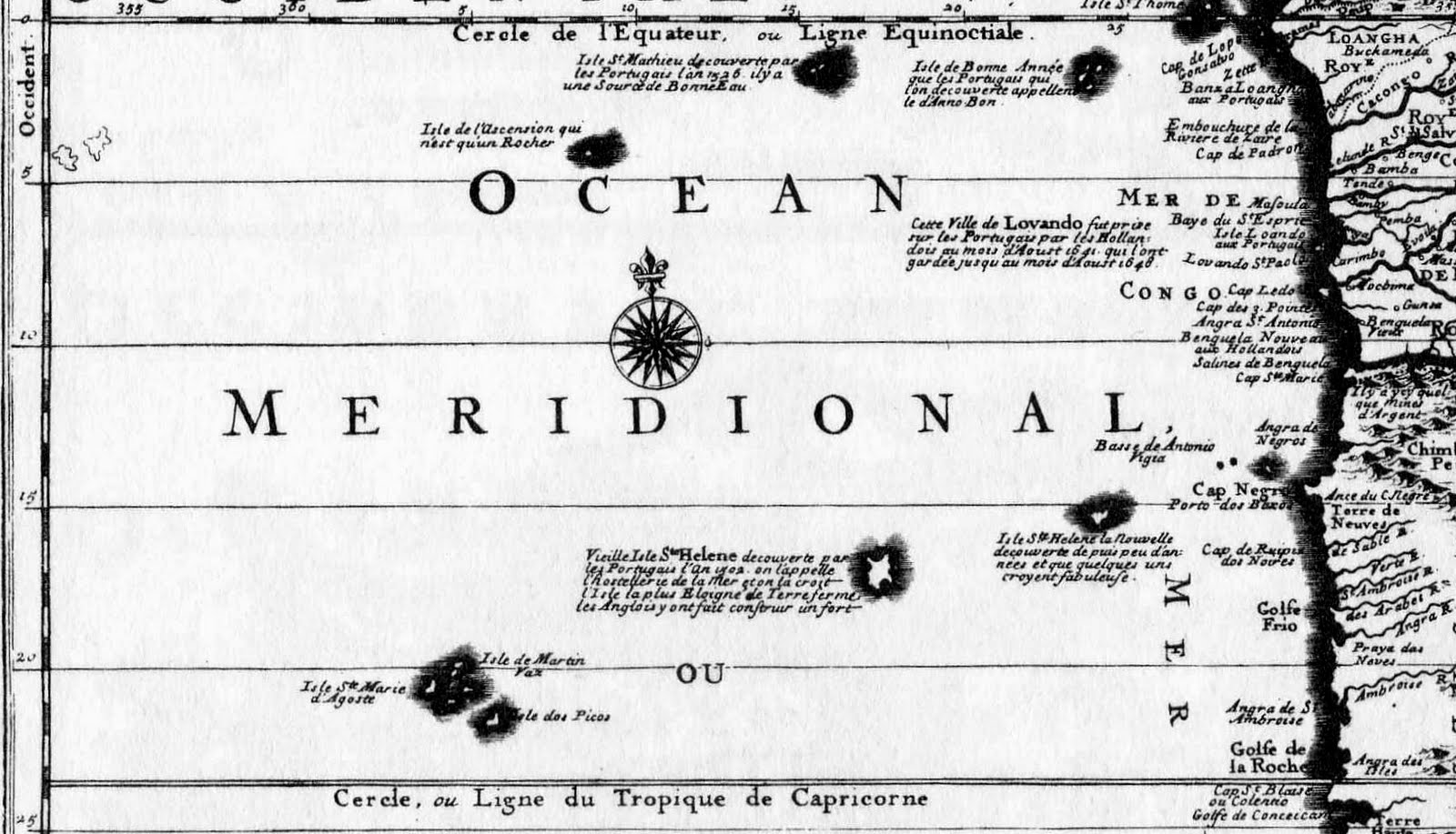
St. Matthew Island and two St. Helenas

1519, St. Helena, Atlas Nautique du Monde, Biblioteheque National de France
The genesis of this post was the page in the Maps and Views section of Barry Weaver’s St Helena Virtual Library and Archive illustrated by a part of Jansson’s 1646 map “Mar di Æthiopia Vulgo Oceanus Æthiopicus which describes the appearance, on early maps, of the mythical islands of New St. Helena and St. Matthew.  It can be accessed here: http://www.bweaver.nom.sh/maps/jansson.htm 

As he suggests: “the mislocation of islands was inevitable given the large navigational errors common in the sixteenth and seventeenth centuries, but once added to sea charts such islands proved extremely resilient, even in spite of a lack of any further evidence to support their existence.”

1547,Vallard Atlas, St. Matthew and St. Helena, South Orientation
Click on images to enlarge

1554, Gastaldi, St. Matthew and St. Helena, South Orientation

1570, Ortelius, St. Matthew

1596, Linschoten, St. Matthew and St. Helena

In 1656 Peter Mundy refers to St Matthew Island when writing about Ascension:
Soe now againe concerning the Ascention birds allsoe, thatt can neither fly nor swymme.  The iland beeing aboutt 300 leagues from the coast of Guinnea and 160 leagues from the iland of St Matheo, the nearest land to it, the question is, how they shold bee generated, whither created there from the beginning, or thatt the earth produceth them of its owne accord, as mice, serpentts, flies, wormes, etts, insects, or whither the nature of the earth and climate have alltred the shape and nature of some other foule into this, I leave it to the learned to dispute of.

By 1634, in addition to St. Matthew, a second St. Helena started to appear on Maps and Charts.

1634, Guerard, Carte Universelle Hydrographique, Biblioteque National de France


1664, Du Val, I Ste Helene la nouvelle

1689, Coronelli

Though admitting that the New Isle of St Helena was thought by many to be legendary, St. Matthew is described as having a small lake of good fresh water and that it was discovered in 1526.

1706, Schenck

1717, Nicholas de Fer

1722, Nicholas de Fer
De Fer repeats the same information about St. Matthew as the 1689 Coronelli map

On his second voyage Cook sailed on “Resolution” from St. Helena on the 21st May 1775.  On the 31st May he left Ascension and “steered to the northward with a fine gale at S. E. by E.”  “I had a great desire to visit the island of St. Matthew, to settle its situation; but as I found the wind would not let me fetch it, I steered for the island of Fernando de Noronha, on the coast of Brazil in order to determine its longitude, as I could not find this had yet been done.  Carrying on board Kendall’s KI chronometer "Resolution" was the first survey ship to carry such an instrument and had St Matthew existed would have been charted with some accuracy.

Purdy's 1814 "Tables of the observed positions of the principal points and places on the coasts of the Atlantic, Ethiopic and Indian Oceans" casts doubt on the existence of St. Matthew:

"We are told, by several historic geographers, that St. Matthew is an island discovered by the Portuguese, in the year 1516, by whom it was afterwards planted; and that vessels frequently stop here some days to take in refreshments.  Guthrie says (Edition of 1783) the Portuguese " planted and kept possession of it for some time; but afterwards deserted it.  This island now remains uninhabited, having little to invite other nations to settle there, except a small lake of fresh water."

"We think it not improbable that this island, like the Land of Bus, in the Northern Ocean, may have entirely disappeared.  Archihald Dalzel, Governor of Cape Coast Castle, sought for it, without success, in 1799 and 1802, and it appears almost certain, from his routes, between 1 and 2 degrees South, longitude, 3 to 10° W. that it does not exist within this space.  "Mr. Dalzel has made many enquiries among the Portuguese about this island, without meeting with any person who pretended to have seen it, except one, who gave him a rough draught of it, which was laughed at by the other Brasilians, who said he must have been deceived by a cloud."

It did, however, still appear on the 1828 German map below.


Monday, 15 August 2011

The Great Wood Wall

Line of The Wall from Flagstaff

The Great Wood Wall around Middlepoint, crossing Bilberry Field Gut and rising towards Bottom Woods is all that remains of the stone wall built by the East India Company in an attempt to protect its own future wood supplies in The Great Wood from destruction from “browsing by goats and rooting by swine”.  Built in the period 1723 – 1727, mainly by Governor John Smith only about 150 acres were completely enclosed, the scheme was ultimately unsuccessful, none of the original trees remain and only around 800 metres of the original wall.


The best exposition of the "devastation of the native vegetation and the ecological despoilaton" of St. Helena, The Wall and The Vanishing Great Wood can be found in Ashmole and Ashmole, St Helena and Ascension Island: a natural history.  Published by Nelson in 2000.

Looking North towards Flagstaff

Janisch’s Extracts from the St Helena Records describes, year after year, the frustration and impotence of successive Governors to prevent the over-exploitation and ultimately the destruction of the natural assets of St. Helena.   http://openlibrary.org/books/OL23471107M/Extracts_from_the_St._Helena_Records


Rising from Bilberry Field Gut towards Bottom Woods

Both Beatson’s 1816 “Tracts relative to the Island of St. Helena and JC Melliss’ 1875 “Physical, Historical and Topographical Description of the Island” describe in detail, to quote Ashmole “the inexorable progress of the tragedy of the commons, the remorseless destruction of a potentially sustainable resource by a number of independent exploiters following their own self-interest even though the result in the long run is a disaster for everyone.

Looking South-East across Bilberry Field Gut

Alfred Russel Wallace in “Island Life” published in1880 summarised the effects on St. Helena by European occupation. When first discovered, in the year 1501, St. Helena was densely covered with luxuriant forest vegetation, the trees overhanging the seaward precipices and covering every part of the surface with an evergreen mantle.  This indigenous vegetation has been almost wholly destroyed; and although an immense number of foreign plants have been introduced, and have more or less completely established themselves, yet the general aspect of the island is now so barren and forbidding that some persons find it difficult to believe that it was once all green and fertile.  The cause of the change is, however, very easily explained.  The rich soil formed by decomposed volcanic rock and vegetable deposits could only be retained on the steep slopes so long as it was protected by the vegetation to which it in great part owed its origin.  When this was destroyed, the heavy tropical rains soon washed away the soil, and left a vast expanse of bare rock or sterile clay.  This irreparable destruction was caused in the first place by goats, which were introduced by the Portuguese in 1513, and increased so rapidly that in 1588, they existed in thousands.  These animals are the greatest of all foes to trees, because they eat off the young seedlings, and thus prevent the natural restoration of the forest.  They were, however, aided by the reckless waste of man.  The East India Company took possession of the island in 1651, and about the year 1700 it began to be seen that the forests were fast diminishing, and required some protection.  Two of the native trees, redwood and ebony, were good for tanning, and to save trouble the bark was wastefully stripped from the trunks only, the remainder being left to rot; while in 1709 a large quantity of the rapidly disappearing ebony was used to burn lime for building fortifications.  By the records quoted in Mr. Melliss' interesting volume on St. Helena it is evident that the evil consequences of allowing the trees to be destroyed were clearly foreseen, as the following passages show: "We find the place called the Great Wood in a flourishing condition, full of young trees, where the hoggs (of which there is a great abundance) do not come to root them up.  But the Great Wood is miserably lessened and destroyed within our memories, and is not near the circuit and length it was.  But we believe it does not contain now less than fifteen hundred acres of fine woodland and good ground, but no springs of water but what is salt or brackish, which we take to be the reason that that part was not inhabited when the people first chose out their settlements and made plantations; but if wells could be sunk, which the governor says he will attempt when we have more hands, we should then think it the most pleasant and healthiest part of the island. But as to healthiness, we don't think it will hold so if the wood that keeps the land warm were destroyed, for then the rains, which are violent here, would carry away the upper soil, and it being a clay marl underneath would produce but little; as it is, we think in case it were enclosed it might be greatly improved" ... "When once this wood is gone the island will soon be ruined" ... "We viewed the wood's end which joins the Honourable Company's plantation called the Hutts, but the wood is so destroyed that the beginning of the Great Wood is now a whole mile beyond that place, and all the soil between being washed away, that distance is now entirely barren."  In 1709 the governor reported to the Court of Directors of the East India Company that the timber was rapidly disappearing, and that the goats should be destroyed for the preservation of the ebony wood, and because the island was suffering from droughts.  The reply was, "The goats are not to be destroyed, being more valuable than ebony." Thus, through the gross ignorance of those in power, the last opportunity of preserving the peculiar vegetation of St. Helena, and preventing the island from becoming the comparatively rocky desert it now is, was allowed to pass away. Even in a mere pecuniary point of view the error was a fatal one, for in the next century (in 1810) another governor reports the total destruction of the great forests by the goats, and that in consequence the cost of importing fuel for government use was £2,729. 7s. 8d. for a single year.


Looking South


Drainage Detail
Looking North into Bilberry Field Gut


Looking South towards Bottom Woods


Rising towards Bottom Woods


Photographs taken in May 2010.