Saturday, 26 March 2011

The Prosperous Bay Signal Station Murder, 1904

A signal station was probably first built at Prosperous Bay about 1770, referred to in records as 'Alarm House'.  Initially relying on alarm guns, during the Napoleonic period a more rapid telegraph system using flags was introduced, and continued until the electric telegraph rendered the semaphore system obsolete in 1866.  The present building marks the return to use of the site in 1887, when it formed part of the newly-established military telephone network and was built to house the telephone equipment and provide living quarters for its operator.  It was connected to Longwood by a 6km stretch of line and poles.  A well-defined and in places excellently preserved track leads up from the plain to the signal station. The military network of communications and defences was effectively abandoned in 1906.
The Signal Station Ruins May 2010.

Edward Gunnell was the signalman at Prosperous Bay Signal Station and when he died in 1899 his son Robert, then aged only 17 took over his duties.  On November 2nd 1904 Robert was found dead by the door of the signal station with a gunshot wound to his head.
The St. Helena Guardian of November 3rd reported:  The public were greatly surprised yesterday morning to learn that Robert Gunnell the Signalman at Prosperous Bay Telegraph Station was found dead by the door of the Station with a wound in his head.  As he was living alone, no one knew of his death until found.  An inquiry is made into the matter, but up to the time of going to Press we have not heard the result.
The 3rd of November entry in The Register of Deaths in the Island of St. Helena records the cause of death of Robert Samuel Gunnell.  Verdict by an Inquest Jury as a case of “wilful murder” against some person or persons unknown.
Arrested on November 4th, Louis Crowie, aged 20, and Richard Crowie, aged 17, were placed in custody.  Tried on the 11th January 1905 at a session of The Supreme Court before His Excellency Henry Galloway, Acting Chief Justice, they were found guilty of Robert’s murder and sentenced to death by hanging.  There were only two defence witnesses and the twenty-three prosecution witnesses included the Inspector of Police and Gaoler who "listened to all the conversations between the two accused and put down as much as possible". The sentence was carried out the following month, the last executions carried out on St. Helena.  A note added to the minutes of the sessions reads: The prisoners were executed on the 2nd Feb at 7.30 am privately at the Customs back shed and there buried in coffins in quick lime.

 
Robert was buried with his father in St Matthew’s Churchyard Hutt’s Gate.
Standing by the grave looking east, the ruins of the now abandoned signal station can be seen on the horizon.
The front page of the St Helena Guardian dated November 10th 1904 had the unfortunate juxtaposition of Mrs Gunnell thanking friends for their kind letters following the death of her son Robert and an advertisement for a replacement Signalman for Prosperous Bay Signal Station where Robert had been murdered six days previously.  This copy was taken at the St. Helena Archives, a fantastic resource for anyone interested in St Helena's history with a most helpful archivist and access to original documentation from 1673 to the present.
I am indebted to Ian Baker in whose book "St. Helena One Man's Island" I first read of the Gunnell Murder, and much else, and which should be read by anyone with an interest in St. Helena, its history and its people.  His book led us to all corners of the island and to a better understanding of this unique place.

The photographs were taken in May 2010

Friday, 25 March 2011

The Boer in the Box, 1901

Andries and his box

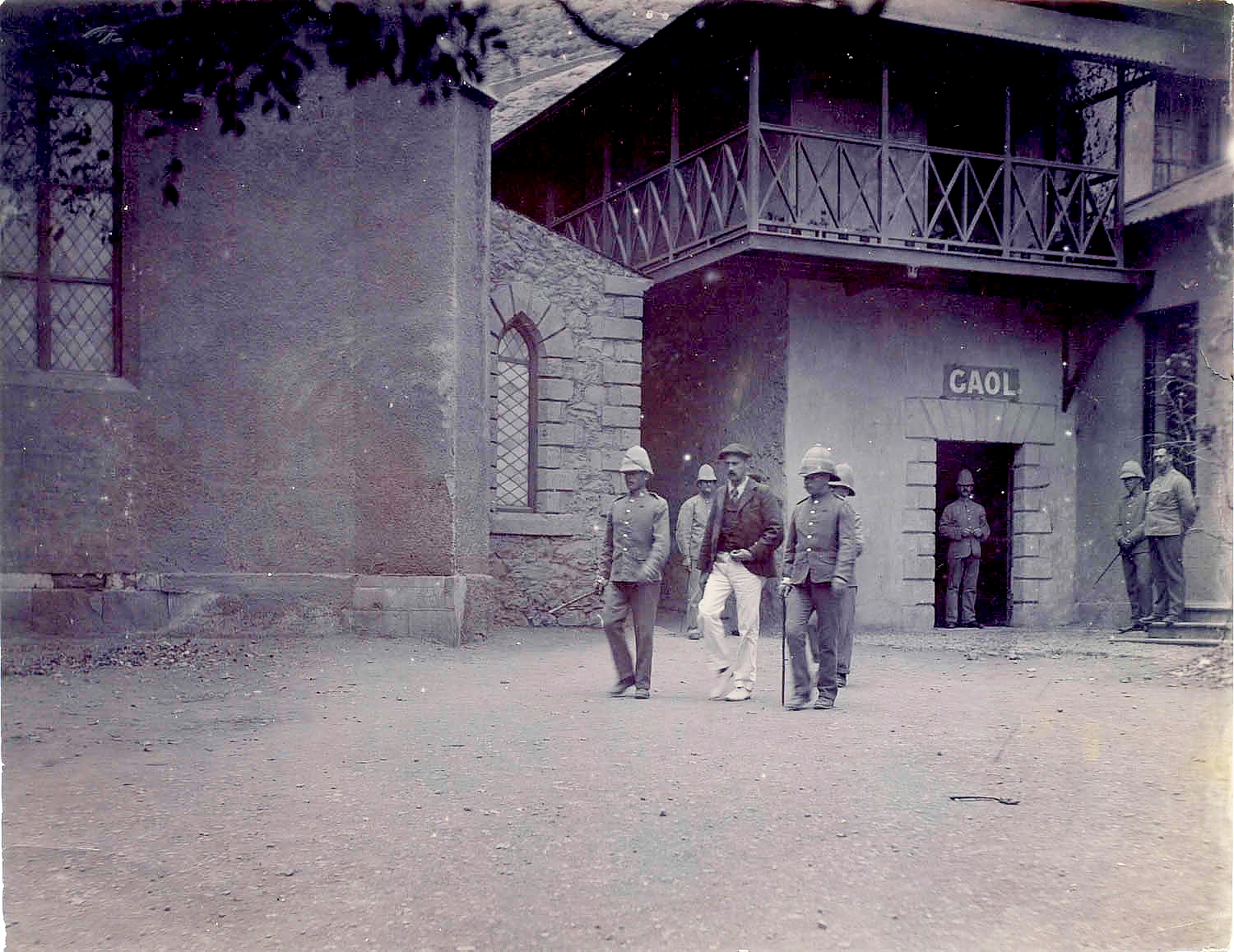
Andries Smorenburg was one of the over 5,000 Boer Prisoners of War sent to St. Helena between April 1900 and February 1902. In December 1901 he made a crate for himself marked "Curios”, ”Handle with Care” and “This Side Up” and "mailed" himself from Saint Helena on the north-bound Union Castle Mail Ship SS Goth.  He prepared his crate by labelling it with a false address in Stroud, Gloucestershire and then packed it with clothing, matches, and enough food and water for 20 days.  Armed with a rough map of Southampton dock, he climbed inside and was loaded aboard.  Despite his labels the crate was tossed about and overturned on board Smorenborg was concussed and lost most of his water.  Having failed to appear at roll-call his disappearance was linked to the mysterious crate and the recent departure of the Goth.  The telegraph cable from St. Helena to Ascension had been laid the previous year so Ascension was warned to look out for him.  In the event  he was discovered by Captain John Attwood on Christmas Day when the ship was out at sea, landed at Ascension, handed over to the authorities and returned to St. Helena.
Photograph courtesy of: http://www.kingsownmuseum.plus.com/ 
Accession Number KO1466/10-077 other details from: http://www.napoleon.org/en/reading_room/articles/files/helena_prison_obey.asp

Andries under Escort outside Jamestown Goal

The New York Times of 27 December 1901 reported as follows: Boer tried to escape in a box.

ASCENCION, Dec 26 - The British steamer, Goth, from South African ports, arrived here today. A Boer prisoner, who was smuggled on board the vessel in a box at St Helena, was handed over to the British naval authorities here.

I believe that the box was taken from St. Helena and the Smorenburg family gave it to Miss Anna Smith of the Johannesburg Museum, now Museum Africa, but I have been unable to confirm this.

A cropped version of the goal picture appears in Emily Jackson's "St Helena The Historic Island" London 1903.
The two lower photographs are taken from:

Augustus Earle, Artist, 1829

Napoleon's Tomb on the Island of St. Helena.  Watercolour by Augustus Earle, 1829. 
http://www.flickr.com/photos/30593522@N05/5539919319/in/set-72157624879923581/ 
The information below has been edited from: http://www.nla.gov.au/exhibitions/earle/essay.html

It is now widely accepted that Augustus Earle, 1793 - 1838  was the first independent, professionally trained artist to visit each of the five continents and record his experiences.  He was not only highly prolific but talented, gregarious and adventuresome as well.

Prior to this time, 'travel' artists had been attached to the various voyages of exploration that set off from Europe during the eighteenth century or had worked abroad under the auspices of wealthy, often aristocratic, patrons.  Earle, however, had no such constraints and was fortunate to be able to combine his wanderlust with the ability to earn a living through art.  The body of work he produced now comprises what is arguably a unique record documenting the effects of European contact and colonisation during the early nineteenth century and chose to execute his impressions of places visited, and cultures and peoples encountered, almost exclusively in watercolour which, unlike oil paints were inexpensive, portable and easy to use.

Born in London in 1793, the son of an American portrait painter, Earle revealed his talents at an early age and from 1806 exhibited with the Royal Academy.  His first recorded works are historical subjects but he also undertook sketching trips outside London in search of local colour and scenery.  He left England in 1815 to visit Malta and the Mediterranean and soon after his return, in March 1818, set off for the United States of America.  Between 1820 and 1829 he travelled around the world with a particular emphasis on Brazil, Tristan da Cunha, New South Wales and New Zealand.  Although best known as a travel artist, Earle also painted oil portraits, historical and ethnographic subjects, and landscapes, executed lithographs, and wrote several publications about his adventures.

It would appear that he spent about eighteen months in the United States of America visiting mainly New York and Philadelphia.  He then left for Rio de Janeiro, was in Chile by June 1820 and took up residence in Lima between July and December that year.  In November 1820 Earle returned to Rio de Janeiro aboard HMS Hyperion and remained there for the next three years.  The city was strategically placed on the southern shipping routes and its natural wonders and architecture had delighted travellers since the eighteenth century.  Furthermore, colonisation and slavery had resulted in an exotic mix of races and customs.

On 17 February 1824, against all advice, he left Rio aboard the decrepit Duke of Gloucester bound for the Cape of Good Hope, and thence Calcutta.  The reason for his hasty departure was a letter containing the most flattering offers of introduction to Lord Amherst, who had just left England to take upon himself the government of India.

Storms forced the ship to anchor off Tristan da Cunha, and attracted by the idea that “this was a spot hitherto unvisited by any artist” Earle went ashore with his dog and a crew member, Thomas Gooch.  His despair when the Duke of Gloucester inexplicably set sail three days later, and disappeared over the horizon can only be imagined.

Tristan da Cunha had remained uninhabited until 1816 when the island group was formally annexed by a garrison from Great Britain.  The troops left the following year but one member, Corporal William Glass, chose to stay behind together with his wife, Maria, whom he had married in Cape Town.  At the time of Earle's arrival, there were six permanent adult inhabitants and several children to whom he became tutor.

Earle was finally rescued on 29 November by the Admiral Cockburn and reached Hobart, whence the ship was bound, on 18 January 1825.  He remained there several months and then set sail for Sydney where he gained a certain amount of acceptance within local society and decided to apply for a land grant.  Although this was denied, due to his lack of capital, he soon established a reputation as the colony's foremost artist and also made several excursions to outlying areas of New South Wales.
In October 1827, Earle left Sydney aboard the Governor Macquarie to visit New Zealand, where he had “hopes of finding something new for my pencil in their peculiar and picturesque style of life.”  He left in April 1828

He then spent several months back in Sydney before departing in October 1828, bound for India.  At Madras he acquired both fame and money; and during his short stay there executed the original drawings of that Presidency, which have been since copied and exhibited as a Panorama, by Messrs. Daniell and Parris.  While in the zenith of his celebrity, his health unfortunately declined, and he was advised to leave India with as little delay as possible.
A view of Jamestown and Ladder Hill, St. Helena 1829 http://nla.gov.au/nla.pic-an8334328

Earle caught two further boats back to England travelling via Mauritius, where he executed a panorama, and St Helena, and finally arrived home in late 1829.  He wasted no time in capitalising on his experiences abroad and published an eight-part series of Sydney views as well as an illustrated account of New Zealand and Tristan da Cunha.  A series of New Zealand views also appeared in 1838.  Towards the end of 1831 Earle again left England, this time as a draughtsman aboard the, HMS Beagle.  When the Beagle arrived in Brazil and set about mapping the coast, Darwin, Earle and one other, took the opportunity to set up house together in Rio de Janeiro for a few months. Apart from being a fine painter, Earle was a bon vivant with an eye for adventure, travel and the ladies and having lived in Rio for over three years on a previous excursion he made an excellent guide for Darwin.  Sadly after a brief period in South America, was forced to resign due to ill health.  He went back to London and died at his residence on 10 December 1838.


Raffles and Napoleon, 1816


Sir Thomas Stamford Bingley Raffles 1781 - 1826
Painting by George Francis Joseph 1817, National Portrait Gallery London.

In October 1815 Stamford Raffles the Lieutenant-Governor of Java and an East India Company employee, was recalled to London to explain the sale of Government land to bolster a shaky paper currency. (He had joined the EIC as a junior clerk in London in 1795, aged 14.)  He sailed from Batavia on 25th March 1816 and on the 18th May 1816, en route to England, his ship called at St. Helena.  On the 19th May he visited Napoleon.  Callers at St Helena mostly on their way to and from The Cape were very numerous during the Captivity and it was always their ambition, frequently unrealised to see Napoleon.  Christopher Kelley in an 1834 publication recounts that  On the arrival of a fleet from India, at St Helena, the Countess of Loudon paid a visit to the Governor at Plantation House; and, for the gratification of her curiosity, Buonaparte was invited to a dinner of ceremony given by Sir Hudson Lowe.  The wily Corsican, however, conjectured the cause of his being invited and refused even to return an answer to the Governor’s card and the Countess felt greatly disappointed at being obliged to leave St. Helena without seeing Napoleon.  Raffles was therefore privileged to be received.

William Warden, Surgeon on board the Northumberland, relates the following in his 1816 publication “Letters Written on Board His Majesty’s Ship the Northumberland, and Saint Helena in which the conduct and conversations of Napoleon Buonaparte, and his suite during the voyage, and the first months of his residence in that island are faithfully described and related”

I happened to be at Longwood, when Mr. Raffles, the late Governor of Java, and his suite, obtained permission to visit the grounds at Longwood.  The anxiety of that gentleman to see Buonaparte was extreme: his curiosity was a perfect rage, and the utmost was done to accomplish its gratification.  In short, though indisposition might have been pleaded, an hour was appointed by the Emperor to receive the Ex-Governor; and the latter had not words to express his delight at the manner in which he had been received.

Whilst Raffles may have been anxious to visit, he left with a distinctly poor impression writing:  ”I saw in him a man determined and vindictive, without one spark of soul, but possessing a capacity and talent calculated to enslave mankind. I saw in him all this capacity, all this talent, was devoted to himself and his own supremacy. I saw that he looked down on all mankind as his inferiors, and that he possessed not the smallest particle of philosophy. I looked upon him as a wild animal caught, but not tamed. He is, in short, all head and no heart – a man who may by his ability command respect, but by his conduct can never ensure the affection of anyone.”

H E Egerton writing in "Sir Stamford Raffles" Talking with Napoleon, St Helena.  On our approaching, Napoleon turned quickly around to receive us, and, taking off his hat, put it under his arm.  His reception was not only not dignified or graceful but absolutely vulgar and authoritative.  He put a series of questions to Mr. Raffles in such quick succession as to render it impossible to reply to one before another was put.  His first request was to have Mr. Raffles's name pronounced distinctly.  He then asked him in what country he was born?  How long had he been in India?  Whether he had accompanied the expedition against the Island of Java?  All these questions were put with great rapidity and, before replied to, he turned round to Capt. Garnham and myself, asked our names and what service we had seen.  On his making a slight inclination of the head, we prepared to take our leave, and on making our bow we parted. Napoleon continued his walk and we returned to the house.
New York Times September 30th 1900.

Bencoolen


St. Helena, Bencoolen, Looking West, May 2010
In 1685 the British East India Company established a pepper trading centre and garrison at Bencoolen on the southern part of the west coast of Sumatra, after which this hill was named. St. Helena and Bencoolen were linked through the EIC by trade and personnel.
Isaac Pyke was Governor of St Helena from July 1714 to June 1719 when he was transferred to Bencoolen as Deputy Governor. He returned as Governor of St. Helena from March 1731 and died in office in July 1738.  During his second term of office he was accused of arbitrary conduct, white inhabitants were ignominiously whipped and imprisoned for trivial offences, he gave full scope to his own tyranny and was judged unfit to be any longer trusted with the power he had so grossly abused. The Court of Directors of The East India Company dismissed him but he died prior to the receipt of their orders to this effect.  From Brooke History of St. Helena to 1806.
From the St. Helena Records June 24th 1736. Francis Everest Governor of Bencoolen died at St Helena on his homeward passage.
In October 1815 Stamford Raffles the Lieutenant-Governor of Java and an East India Company employee, was recalled to London to explain the sale of Government land to bolster a shaky paper currency.  (He had joined the EIC as a junior clerk in London in 1795, aged 14.)  He sailed from Batavia on 25th March 1816 and en route to England his ship called at St. Helena and he visited Napoleon, arriving in London on the 16th July, a four month passage.

In February 1817 The EIC Directors exonerated him from dishonourable motives and confirmed his appointment as Lieutenant-Governor of the West Sumatra Residency at Bencoolen and in May 1817 he was knighted.  Benkulen (sic) was, declared Raffles the most wretched place I ever beheld.  It was not a popular destination, only the disgraced and the truly desperate found their way there. Four of the five children born to Raffles and his second wife Sophia died in infancy at Bencoolen.  Indian convicts were first transported to Bencoolen in 1787.  In 1819 Raffles was sent by Lord Hastings (Governor General of India 1813-1823) to acquire Singapore and this led to negotiations with the Dutch conducted in London and concluded by a treaty in 1824.  Under this treaty the British withdrew from Sumatra and the East India Company ceded Bencoolen to the Dutch, who on their part transferred all their possessions in India including their factories at Dacca, the settlement of Malacca with the British given undisputed possession of Singapore.  Following this treaty and the British withdrawal the Bencoolen convicts were transferred to Penang and Singapore.  See The Honourable Company John Keay Harper Collins 1991

Irish Republican Prisoners, 1922

The reverse of The Great Seal of the Irish Free State.

The Irish Free State Plans to Transport Republican Prisoners to St. Helena 1922.
Between 1922 and 1937 the Irish Free State, Saorstat Éireann, was name of the state comprising the 26 of Ireland's 32 counties, which were separated from the United Kingdom under the Irish Free State Agreement (or Anglo-Irish Treaty) signed by British and Irish Republic's representatives in London on December 6, 1921.  The Irish Free State came into being in December 1922, replacing two co-existing but nominally rival states, the de jure Southern Ireland, which had been created by the Government of Ireland Act, 1920 and which from January 1922 had been governed by a Provisional Government under Michael Collins and the de facto Irish Republic under the President of Dáil Éireann, Arthur Griffith, which had been created by Dáil Éireann in 1919.

The contents of the Treaty divided the Irish Republic's leadership, with the President of the Republic, Éamon de Valera, leading the anti-Treaty minority and the split eventually led to the Irish Civil War of 1922/23.  In 1922 the two main Irish signatories, President Griffith and Michael Collins, both died. Griffith died partially from exhaustion; Collins, at the signing of the Treaty, had said that in signing it, he may have signed his "actual death warrant" and he was correct: he was assassinated by anti-Treaty republicans in August 1922, barely a week after Griffith's death.  With the deaths of their leaders both states in effect merged and both posts came to be held simultaneously by W.T. Cosgrave.
As the anti-Treaty military effort collapsed towards the end of 1922, thousands of prisoners fell into Free State hands, reaching 12,000 by early 1923.  Such numbers placed a massive strain on the meagre resources of the new state.  At a meeting of the Executive Council on 19 September 1922, it was agreed that the British government would be requested to make the island of St Helena available for the internment of captured republicans.
Minister for External Affairs Desmond FitzGerald would undertake the necessary preliminary negotiations with Alfred Cope at the British Colonial Office and report back as soon as possible.  Cope, Assistant Under-Secretary for Ireland before the truce of 1921, had been instrumental in keeping channels of communication open between Sinn Féin leaders and Lloyd George.  During the early post-Treaty period he enjoyed the friendship and confidence of FitzGerald and other members of the Provisional Government.  As Secretary of State for the Colonies he was responsible for relations with the Irish Provisional Government, and especially for the implementation of the Treaty. Another former under-secretary in the Dublin Castle administration, Mark Sturgis, who worked at the Irish Office in 1922, took charge of the St Helena negotiations on the British side.
The Provisional Government pursued the St Helena project with enthusiasm.  On 20 November 1922 FitzGerald visited Sturgis at the Irish Office.  Within two days Sturgis, having made detailed enquiries, was able to provide FitzGerald with the broad outlines of a possible scheme, incorporating suggestions for the provision of hutments and transport.  A complete hutted camp at Brockton in Derbyshire could be dismantled and conveyed to Liverpool at a cost of £2–3000. Its re-erection in St Helena would be a matter for the Irish authorities.  Sturgis had in mind a more convenient but more expensive option: the placing of an order with a contractor normally used by the War Office for the erection of a camp for a specified number of men, complete with water supply, drainage and lighting.  When FitzGerald conveyed these recommendations to the Executive Council on 23 November, he was directed to obtain inclusive estimates for the work from the firm acting for the War Office.
By the 7th December Sturgis was able to tell FitzGerald that he had been able to arrange with Lt. Col. P.N. Nissen DSO, head of the firm of contractors, to discuss the possibilities of the St Helena scheme with a representative of the Executive Council.  FitzGerald sent M.J. Burke, an official of the Board of Works responsible for the construction of internment camps in the Free State, to meet British officials in London on 18 December.  Burke’s lengthy report, completed in just over a week, was generally optimistic about the feasibility of the project, and offers an interesting account of the conditions Irish republican prisoners could expect to experience during their period of incarceration on the island.  According to Burke, St Helena would be a pleasanter place of detention than Mountjoy, Limerick, Arbour Hill or the internment camps elsewhere in Ireland.  Climatic conditions were ideal for most of the year, with little variation between summer and winter temperatures.  Even on the colder heights where a camp could most fittingly be located, the lowest winter temperature would seldom fall below 50 degrees Fahrenheit, making the provision of heating virtually unnecessary.
Burke had every confidence in the judgement of Nissen, who was uniquely qualified to offer advice on the housing of internees, having had extensive experience as a prisoner and later as an engineer entrusted with the construction of prisoner-of-war camps on a large scale.  He invented the hut that bears his name, which had evolved in the later stages of the Great War.  Nissen, with Burke’s approval, devised an elaborate scheme for the construction of a camp for every 500 men, with sleeping accommodation of sixty square feet per prisoner, and two dining huts, each with an area of 4000 square feet.  Provision was also made for recreation huts, a small hospital staffed by resident surgeons, sanitary facilities, coal stoves for heating and paraffin lamps for lighting.
Burke and his British advisers gave a good deal of consideration to the question of how large a number of prisoners could be held on St Helena in circumstances most conducive to what Burke described as ‘an orderly and comparatively contented residence’.  At the same time, prisoners had to be prevented from interfering with the amenities of the island.  At first Burke was hopeful that it might be possible to avail of some of the natural features of St Helena to confine the prisoners to an isolated part of the island within which they would have full liberty but beyond which they could not wander. Thus prisoners might enjoy a relatively benign and congenial period of imprisonment, during which ‘a healthy existence with opportunities for occupation in cultivating land and perhaps rearing stock and other occupations of a beneficial character could be afforded’.  On further investigation Burke found that geographical barriers would not facilitate the isolation of any area on the island: an enclosed and guarded camp would have to be created.
On 3 January 1923 the Free State authorities were in possession of enough information to decide on the practicality of the St Helena project.  Nissen’s firm had submitted an estimate of £77,000 for a camp catering for 500 prisoners and 500 guards.  The Board of Works had also commissioned two reports, one from the governor of St Helena on the topography of the island and its resources. He believed that from 2000 to 4000 prisoners might be accommodated in Deadwood in the north-east of the island.  From 1900 to 1902, 2000 Boer prisoners were interned there.  A confidential memorandum from a private source made it clear that the natural resources of St Helena would sustain the large numbers of prisoners the governor had in mind.
When FitzGerald first broached the St Helena proposal with British officials, Lloyd George’s Liberal–Conservative coalition cabinet, which had negotiated the Anglo-Irish Treaty, was still in power. In October 1922 Bonar Law’s Conservative administration replaced it.  In January 1923 the Free State government learned that even if agreement in principle was reached between the two governments, republican prisoners could not be dispatched to St Helena until three months after such an agreement.  One month would be required for collecting the material for the camp prior to shipment, and two months for its installation.  The available documents suggest that the close relationship between the Irish Minister for External Affairs and officials at the Colonial Office in London did not long survive the change of British government.  The new administration did not seem fully informed on what the Irish government had in mind.  The Colonial Office, the British authorities pointed out, would have to maintain a strong military guard, at an estimated cost of £200,000 per annum, to be met from the impoverished Free State exchequer. Irish officials, conscious of the impossibility of meeting such demands, explained that the Free State government wanted the prisoners enclosed in camps inside barbed wire entanglements, with only a token garrison.
The St Helena project remained a live possibility until early 1923, although it never reached the stage at which sanction at government level became an issue.  After this the Free State authorities seem to have lost their earlier enthusiasm for it.  There can be little doubt, however, that in the later part of 1922 the project was pursued with vigour on the Irish government side.  At a time when Republicans were profiting, in propaganda terms, both in Ireland and abroad from the Free State policy of illegal executions of untried prisoners, particularly in November and December 1922, it is difficult to understand the motivation for the St Helena scheme, and the enthusiasm of the government in persisting with it for as long as it did.  It is easy to imagine what its political opponents would have made of the imprisonment by an Irish government of thousands of Irish Republican prisoners, guarded by British troops and housed by a British contractor, on a remote British island to which they had been conveyed by British ships.
The two introductory paragraphs were amended from: http://www.generalmichaelcollins.com/Fine_Gael/Saorstat_Eireann.html 
The bulk of the narrative was taken from the article “On St Helena’s Bleak Shore” available at: http://www.historyireland.com/volumes/volume11/issue1/news/?id=113637 and used with permission of the Editor.
An abridged version of the same article is also available at: http://www.anphoblacht.com/news/detail/2802