Tuesday, 23 August 2011

St. Matthew Island and two St. Helenas

1519, St. Helena, Atlas Nautique du Monde, Biblioteheque National de France
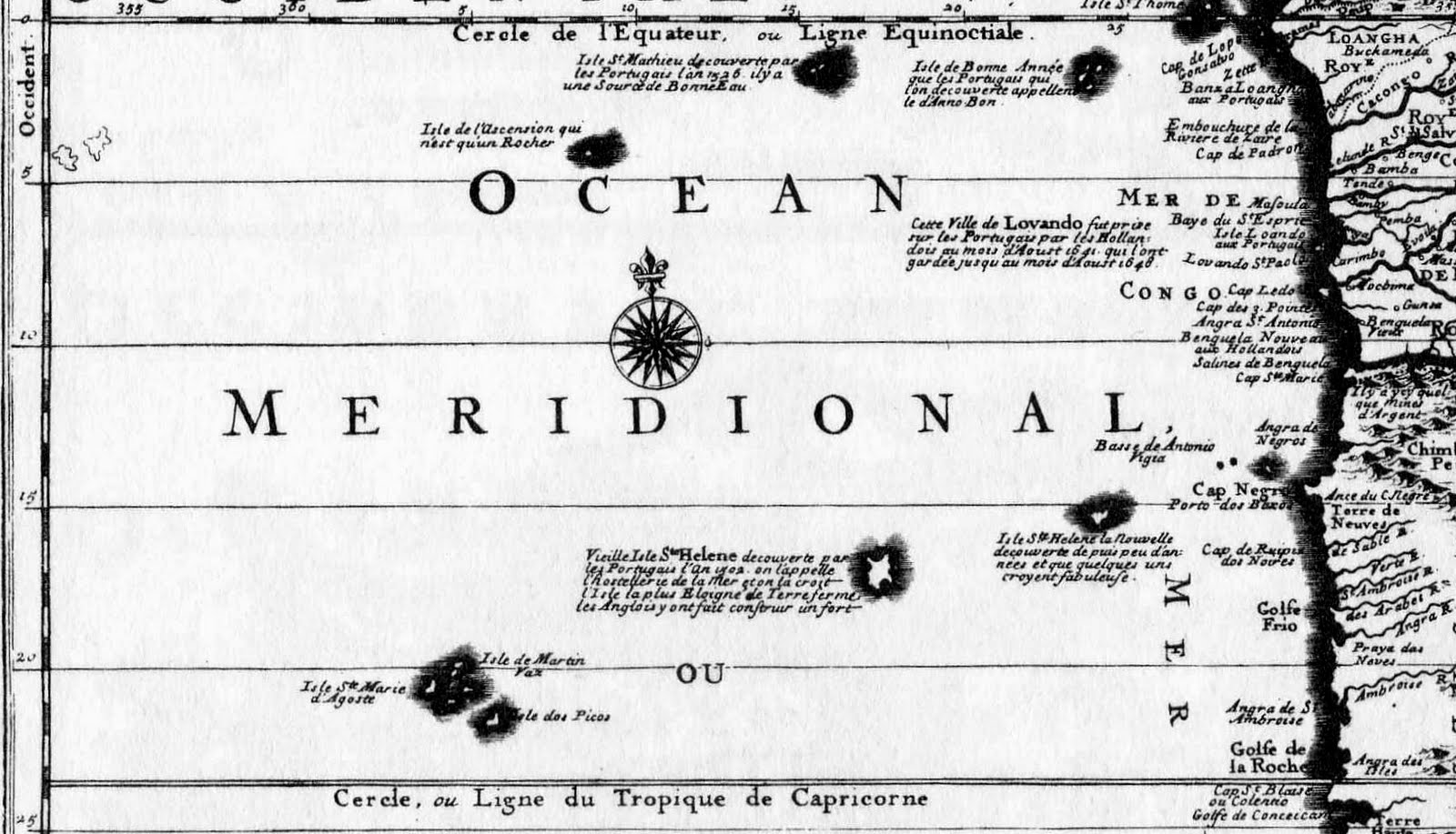
The genesis of this post was the page in the Maps and Views section of Barry Weaver’s St Helena Virtual Library and Archive illustrated by a part of Jansson’s 1646 map “Mar di Æthiopia Vulgo Oceanus Æthiopicus which describes the appearance, on early maps, of the mythical islands of New St. Helena and St. Matthew.  It can be accessed here: http://www.bweaver.nom.sh/maps/jansson.htm 

As he suggests: “the mislocation of islands was inevitable given the large navigational errors common in the sixteenth and seventeenth centuries, but once added to sea charts such islands proved extremely resilient, even in spite of a lack of any further evidence to support their existence.”

1547,Vallard Atlas, St. Matthew and St. Helena, South Orientation
Click on images to enlarge

1554, Gastaldi, St. Matthew and St. Helena, South Orientation

1570, Ortelius, St. Matthew

1596, Linschoten, St. Matthew and St. Helena

In 1656 Peter Mundy refers to St Matthew Island when writing about Ascension:
Soe now againe concerning the Ascention birds allsoe, thatt can neither fly nor swymme.  The iland beeing aboutt 300 leagues from the coast of Guinnea and 160 leagues from the iland of St Matheo, the nearest land to it, the question is, how they shold bee generated, whither created there from the beginning, or thatt the earth produceth them of its owne accord, as mice, serpentts, flies, wormes, etts, insects, or whither the nature of the earth and climate have alltred the shape and nature of some other foule into this, I leave it to the learned to dispute of.

By 1634, in addition to St. Matthew, a second St. Helena started to appear on Maps and Charts.

1634, Guerard, Carte Universelle Hydrographique, Biblioteque National de France


1664, Du Val, I Ste Helene la nouvelle

1689, Coronelli

Though admitting that the New Isle of St Helena was thought by many to be legendary, St. Matthew is described as having a small lake of good fresh water and that it was discovered in 1526.

1706, Schenck

1717, Nicholas de Fer

1722, Nicholas de Fer
De Fer repeats the same information about St. Matthew as the 1689 Coronelli map

On his second voyage Cook sailed on “Resolution” from St. Helena on the 21st May 1775.  On the 31st May he left Ascension and “steered to the northward with a fine gale at S. E. by E.”  “I had a great desire to visit the island of St. Matthew, to settle its situation; but as I found the wind would not let me fetch it, I steered for the island of Fernando de Noronha, on the coast of Brazil in order to determine its longitude, as I could not find this had yet been done.  Carrying on board Kendall’s KI chronometer "Resolution" was the first survey ship to carry such an instrument and had St Matthew existed would have been charted with some accuracy.

Purdy's 1814 "Tables of the observed positions of the principal points and places on the coasts of the Atlantic, Ethiopic and Indian Oceans" casts doubt on the existence of St. Matthew:

"We are told, by several historic geographers, that St. Matthew is an island discovered by the Portuguese, in the year 1516, by whom it was afterwards planted; and that vessels frequently stop here some days to take in refreshments.  Guthrie says (Edition of 1783) the Portuguese " planted and kept possession of it for some time; but afterwards deserted it.  This island now remains uninhabited, having little to invite other nations to settle there, except a small lake of fresh water."

"We think it not improbable that this island, like the Land of Bus, in the Northern Ocean, may have entirely disappeared.  Archihald Dalzel, Governor of Cape Coast Castle, sought for it, without success, in 1799 and 1802, and it appears almost certain, from his routes, between 1 and 2 degrees South, longitude, 3 to 10° W. that it does not exist within this space.  "Mr. Dalzel has made many enquiries among the Portuguese about this island, without meeting with any person who pretended to have seen it, except one, who gave him a rough draught of it, which was laughed at by the other Brasilians, who said he must have been deceived by a cloud."

It did, however, still appear on the 1828 German map below.


Monday, 15 August 2011

The Great Wood Wall

Line of The Wall from Flagstaff

The Great Wood Wall around Middlepoint, crossing Bilberry Field Gut and rising towards Bottom Woods is all that remains of the stone wall built by the East India Company in an attempt to protect its own future wood supplies in The Great Wood from destruction from “browsing by goats and rooting by swine”.  Built in the period 1723 – 1727, mainly by Governor John Smith only about 150 acres were completely enclosed, the scheme was ultimately unsuccessful, none of the original trees remain and only around 800 metres of the original wall.


The best exposition of the "devastation of the native vegetation and the ecological despoilaton" of St. Helena, The Wall and The Vanishing Great Wood can be found in Ashmole and Ashmole, St Helena and Ascension Island: a natural history.  Published by Nelson in 2000.

Looking North towards Flagstaff

Janisch’s Extracts from the St Helena Records describes, year after year, the frustration and impotence of successive Governors to prevent the over-exploitation and ultimately the destruction of the natural assets of St. Helena.   http://openlibrary.org/books/OL23471107M/Extracts_from_the_St._Helena_Records


Rising from Bilberry Field Gut towards Bottom Woods

Both Beatson’s 1816 “Tracts relative to the Island of St. Helena and JC Melliss’ 1875 “Physical, Historical and Topographical Description of the Island” describe in detail, to quote Ashmole “the inexorable progress of the tragedy of the commons, the remorseless destruction of a potentially sustainable resource by a number of independent exploiters following their own self-interest even though the result in the long run is a disaster for everyone.

Looking South-East across Bilberry Field Gut

Alfred Russel Wallace in “Island Life” published in1880 summarised the effects on St. Helena by European occupation. When first discovered, in the year 1501, St. Helena was densely covered with luxuriant forest vegetation, the trees overhanging the seaward precipices and covering every part of the surface with an evergreen mantle.  This indigenous vegetation has been almost wholly destroyed; and although an immense number of foreign plants have been introduced, and have more or less completely established themselves, yet the general aspect of the island is now so barren and forbidding that some persons find it difficult to believe that it was once all green and fertile.  The cause of the change is, however, very easily explained.  The rich soil formed by decomposed volcanic rock and vegetable deposits could only be retained on the steep slopes so long as it was protected by the vegetation to which it in great part owed its origin.  When this was destroyed, the heavy tropical rains soon washed away the soil, and left a vast expanse of bare rock or sterile clay.  This irreparable destruction was caused in the first place by goats, which were introduced by the Portuguese in 1513, and increased so rapidly that in 1588, they existed in thousands.  These animals are the greatest of all foes to trees, because they eat off the young seedlings, and thus prevent the natural restoration of the forest.  They were, however, aided by the reckless waste of man.  The East India Company took possession of the island in 1651, and about the year 1700 it began to be seen that the forests were fast diminishing, and required some protection.  Two of the native trees, redwood and ebony, were good for tanning, and to save trouble the bark was wastefully stripped from the trunks only, the remainder being left to rot; while in 1709 a large quantity of the rapidly disappearing ebony was used to burn lime for building fortifications.  By the records quoted in Mr. Melliss' interesting volume on St. Helena it is evident that the evil consequences of allowing the trees to be destroyed were clearly foreseen, as the following passages show: "We find the place called the Great Wood in a flourishing condition, full of young trees, where the hoggs (of which there is a great abundance) do not come to root them up.  But the Great Wood is miserably lessened and destroyed within our memories, and is not near the circuit and length it was.  But we believe it does not contain now less than fifteen hundred acres of fine woodland and good ground, but no springs of water but what is salt or brackish, which we take to be the reason that that part was not inhabited when the people first chose out their settlements and made plantations; but if wells could be sunk, which the governor says he will attempt when we have more hands, we should then think it the most pleasant and healthiest part of the island. But as to healthiness, we don't think it will hold so if the wood that keeps the land warm were destroyed, for then the rains, which are violent here, would carry away the upper soil, and it being a clay marl underneath would produce but little; as it is, we think in case it were enclosed it might be greatly improved" ... "When once this wood is gone the island will soon be ruined" ... "We viewed the wood's end which joins the Honourable Company's plantation called the Hutts, but the wood is so destroyed that the beginning of the Great Wood is now a whole mile beyond that place, and all the soil between being washed away, that distance is now entirely barren."  In 1709 the governor reported to the Court of Directors of the East India Company that the timber was rapidly disappearing, and that the goats should be destroyed for the preservation of the ebony wood, and because the island was suffering from droughts.  The reply was, "The goats are not to be destroyed, being more valuable than ebony." Thus, through the gross ignorance of those in power, the last opportunity of preserving the peculiar vegetation of St. Helena, and preventing the island from becoming the comparatively rocky desert it now is, was allowed to pass away. Even in a mere pecuniary point of view the error was a fatal one, for in the next century (in 1810) another governor reports the total destruction of the great forests by the goats, and that in consequence the cost of importing fuel for government use was £2,729. 7s. 8d. for a single year.


Looking South


Drainage Detail
Looking North into Bilberry Field Gut


Looking South towards Bottom Woods


Rising towards Bottom Woods


Photographs taken in May 2010.


Monday, 18 July 2011

Maskelyne Vault

A recent visit to Wiltshire gave me the opportunity to visit Purton where, since the sixteenth century, the Maskelyne family had been significant landowners and where Nevil’s father Edmund lived.  Though Nevil himself was born in London in 1732 and died at Greenwich in 1811, the family connection led to him being buried on the South side of the Parish Church of St Mary’s.

St Mary's Church, Purton, June 2011
Designated a Grade 1 listed building, St Mary’s is one of only three churches in England to have both a western tower and a central spire.

St Mary's Purton, Western Tower, June 2011

The central tower was built in c.1325 and the transepts were also added in the 14th century. The chapel on the southern side of the chancel is mid 14th century and the decorated piscina indicates that it was a chantry chapel.  In the 15th century the north and south aisles were rebuilt and the nave walls raised by about three feet. The west tower was built in the latter part of the 15th century and the building of this caused alterations to be made to the chancel.  In 1872 restoration was carried out and included rebuilding three walls of the chancel. During the work the walled up skeleton of a woman was found in a room or chapel in the north transept.  The reason she was there remains an unsolved mystery. In 1977 wall paintings were uncovered and the best of these being the Death of the Virgin on the south wall of the Lady Chapel.

Inside the Church is a memorial plaque to Maskelyne.

The inscription reads: In this cemetery of this Church are laid the remains of Nevil Maskelyne STPRSS and also Astronomer Royal, a man, whether you should look at simplicity of manners, kindness of heart or the usefulness of a most learned life, (was) outstanding and illustrious, deserving public lament, who in describing the laws of nature worshipped above all the great Creator: sincerely pious, he displayed his piety in doing his duty; finally trusting not in himself but in Christ he gave up his well lived life into the lap of the everlasting Father in sure hope of reward to come. On the 9th Feb. the year of the Lord 1811.
STP Sacrae Theologiae Professor - Doctor of Theology
RSS Regalis Societatis Sodalis - Fellow of the Royal Society

Maskelyne Vault, June 2011

Inscription to Sophie, Widow of Nevil Maskelyne

Inscription to Margaret, Daughter of Nevil and Sophie Maskelyne


In Madras in 1753 Maskelyne’s seventeen year old sister, Margaret, married Robert Clive who had been sent out to India ten years previously as a “writer” in the service of The East India Company.  Later better known as Clive of India he is credited with securing India, and the wealth that followed, for the British crown and together with Warren Hastings he was one of the key figures in the creation of British India.

Wednesday, 29 June 2011

Maskelyne, Mason and Dixon, 1761

2011 is the 250th Anniversary of Nevil Maskylene’s visit to St. Helena to observe the June 1761 Transit of Venus and is also the bicentenary of his death.  Charles Mason and Jeremiah Dixon visited St Helena in October the same year returning from observing the Transit in South Africa.

When I first started reading about Maskelyne the most widely available picture of him was the one below.
Nevil Maskelyne by John Downman, BHC 2854. National Maritime Museum

The Board of Longitude blog, http://www.nmm.ac.uk/blogs/longitude/2011/04/a-mystery-astronomer.html recently posted that the National Maritime Museum now describe this picture as "Formerly called Nevil Maskelyne" as there is some doubt that it is of Maskelyne for the sensible reason that it does not look all that much like the other known portraits.  The late Derek Howse, formerly Head of Astronomy at NMM and biographer of Maskelyne firmly believed that this portrait is misidentified on the basis of its great dissimilarity to Louis van der Puyl's undoubted Maskelyne portrait of 1785 owned by the Royal Society and that this otherwise fine portrait is therefore probably another astronomer, so far unidentified.


Van der Puyl shows him in clerical dress appropriate to his formal status as a clerk in Holy Orders against the background of the Royal Observatory, Greenwich.


In 1716 Edmond Halley, who had visited St Helena in 1677 and 1700, noted that an accurate timing of the transit of Venus would aid the calculation of the distance between the Earth and the Sun.  Although Halley knew he would not live to see the next anticipated Venus transit in 1761, his detailed plans and papers ensured that expeditions were sent out to the furthest reaches of the globe to make observations.  The 1761 transit  observations constituted the largest international scientific undertaking up to that time and despite the fact that it took place during the latter half of the Seven Years' War (1756-1763), a worldwide conflict involving the major powers of the time and their colonies, it was to be observed by many astronomers at over one hundred locations involving 170 observers scattered from Peking to Newfoundland though, as we shall see, not always from the location planned.
Janisch records that The Directors of the East India Company in London wrote to The Governor of St Helena (Letters from England, Dec. 31, 1760)
His Majesty having been graciously pleased to encourage the making observations on the transit of the planet Venus over the Sun's disk on the 6th June next and proper persons being engaged by the Royal Society for the purpose two of them, Mr. Charles Mason and Mr. Jeremiah Dixon proceed to Fort Marlborough* on H. M. Ship Seahorse and the other two Revd. Mr. Nevil Maskelyne and Mr. Robert Waddington take passage on the Prince Henry to St. Helena.  As this is done to make some improvements in Astronomy which will be of general utility the two last named gentlemen are upon their arrival and during their stay to be accommodated by you in a suitable manner with diet and apartments at the Company's expense and you are to give them all the assistance as to materials, workmen, and whatsoever else the service they are employed upon may require.

*Fort Marlborough was the EIC base at Bencoolen, a pepper trading centre on the southern part of the west coast of Sumatra.  A garrison had been established there in 1685 and the Fort was built in 1714.  St Helena and Bencoolen were linked both through trade and personnel.

The Governor replied (Letter to England, May 26, 1761)

Rev. Nevil Maskelyne and Mr. Robt. Waddington shall be accommodated in a suitable manner with diet and apartments at the Company's expense. We have already erected an observatory for them in the country and shall furnish whatever else the service may require.

Transit Diagram

A graduate of Trinity College, Cambridge, Maskelyne (1732 - 1811) became assistant to the then Astronomer Royal, Bradley, in 1757.  He left England for St. Helena in January 1761 to observe the June 6th transit, with the aim of using this information to calculate the distance of the Earth from the Sun.  Having set up his observatory on the high ridge behind Alarm House low cloud prevented any useful observations being made, though several people reportedly saw it in Jamestown.  He returned to England in May 1762. 
He evidently had a taste for good living. Chambers Edinburgh Journal for 1848 records the following in regard to his trip. “In a curious estimate which he drew up of his expenses for the voyage and sojourn on the island for one year we find 13 guineas set down for washing, for board 109 guineas, for liquors 141 guineas. 5 shillings per day was reckoned as the charge for drink while on the island and £50 for the same item for the voyage out and home.  Maskelyne was a clergyman but his habits would have ill accorded with our present notions of temperance.”
Mason and Dixon are remembered today primarily for their work between 1763 and 1767 in the resolution of a border dispute between British colonies of Maryland and Pennsylvania/Delaware in Colonial America. The disputants, the Calverts of Maryland and the Penns of Pennsylvania, engaged the astronomer Mason and surveyor Dixon, to survey what became known as the Mason–Dixon Line, and paid £3,512 to have the 327 miles surveyed.  In popular usage, especially since the Missouri Compromise of 1820, the Mason Dixon Line symbolises a cultural boundary between the Northeastern United States and the Southern United States (Dixie).
Having been chosen, in 1760, by the Royal Society to go to Bencoolen to observe the 1761 transit Mason suggested that Dixon should go as his assistant.  On January 10th 1761 their ship, the HMS Seahorse, was attacked by L’Grande a 34 gun French frigate and they had to return to Portsmouth with 11 killed and 37 wounded. Wanting to call the expedition off they were threatened with dire personal consequences “they may assure themselves of being treated by the Council with the most inflexible resentment, and prosecuted with the utmost Severity of Law” and were prodded back to sea by the Royal Society. Their second voyage wouldn't have got them to Sumatra in time (and Bencoolen had been captured by the French in August 1760), so they stopped at Cape Town, South Africa, as guests of the local governor and set up their equipment. They obtained several accurate measurements of Venus's position on the solar disc, providing some of the most useful data from the 1761 event, as it was the only successful observation made from the Southern Hemisphere.  On the passage home, they stopped at St Helena in October and, after discussion with Maskelyne, who had failed to observe the transit there, Dixon returned temporarily to the Cape with Maskelyne's clock to carry out gravity experiments.  Returning via St Helena he and Mason reached England in February 1762, each £230 richer. 

Despite being watched by so many observers the results were disappointing.  Bad weather, navigational errors, and difficulty timing Venus's image against the sun, all contributed to the failure and with no method for accurately calculating the longitude of most observation sites, no useful results were obtained.  Venus was expected to transit the Sun again on 3 June 1769, but if this opportunity was also lost, it would be another 105 years before the transit next occurred and another attempt at recording it could be made.
With this in mind, in 1768 the Royal Society sent a petition to King George III requesting assistance to send a scientific expedition to the South Seas to observe the forethcoming transit.  The petition, supported by the Greenwich Observatory, sought the sum of £4,000 to defray the costs of a Pacific expedition which would, it was stressed, enhance Britain’s imperial ambitions and scientific reputation, and improve navigation and trade.  The petition was soon approved.  Maskelyne, by this time Astronomer Royal and fellow of the Royal Society, had calculated that the best possible vantage point south of the equator was between the Marquesas Islands and Tonga.  The Royal Society informed the Admiralty that Tahiti, located almost at the centre of the area calculated by Maskelyne was its desired site for the observation of the Transit and also requested that naturalist Joseph Banks and his party be permitted to join the expedition.  In August 1768 HMS Endeavour left Plymouth on Cook’s first voyage of discovery. Cook had much better weather than Maskelyne had on St. Helena, writing: The Measurements gathered by Cook and others in 1769 were pretty rough but could be used to estimate the distance of the Earth from the Sun and, by extension, the size of the solar system and the universe.
June 3rd 1769. "not a clowd seen the whole day, and air perfectly clear, so we had every advantage we could desire in observing the whole passage of the planet Venus over the suns disk".
Returning to England, Cook and Banks spent from 1st to 4th May 1771 on St Helena.

Maskelyne, later known as "The Seaman's Astronomer" used his journey to St Helena to develop a method of calculating longitude called the lunar distance method and he used this method to establish for the first time the precise longitude of St Helena.  A vested interest in an astronomical solution to the longitude problem could have been seen as a conflict of interest, but this did not stop the Board of Longitude sending Maskelyne to Barbados in 1763 to test Harrison's No. 4 timekeeper.  His advocacy of this method meant that he has gone down in history as the villain of the longitude saga, the man who despised and cheated the self-educated genius John Harrison out of the prize he earned for his brilliant timepieces, which helped fix the exact time at sea and so determine longitude and the position of sailing ships on the ocean.
He was appointed the fifth Astronomer Royal in 1765 and died at the Greenwich observatory, still in office after 46 years, in February 1811.  He is buried in the churchyard of St Mary the Virgin, the parish church of the village of Purton Wiltshire where the Maskelynes had lived from the 16th century.

After completing the boundary survey in America, Mason worked under Maskelyne at Greenwich where he contributed to the Nautical Almanac.  In September 1786 he wrote to Benjamin Franklin that he had returned to America with his wife, seven sons, and one daughter.  He provided no explanation for his return and he died on October 26, 1786, in Philadelphia.

On returning to England from America Dixon sailed to Norway in 1769 to observe another transit of Venus after which Dixon resumed his work as a surveyor in Durham.  He died unmarried in January 1779.


Edmund Halley Blog post

The National Maritime Museum and the Department of history and Philosophy of Science, University of Cambridge, are currently working on a five-year research project on the British Board of Longitude, funded by the Arts and Humanities Research Council.

Bencoolen Link.

Cook on St. Helena

Monday, 27 June 2011

Flax

St. Helena, Peakdale, Footpaths through the Flax, May 2010

Among the many hundreds of plants first seen by Europeans on James Cook’s 1768 to 1771 Endeavour Voyage was one described, but not named, by Joseph Banks in his March 1770 “Account of New Zealand”:
“But of all the plants we have seen among these people that which is the most excellent in its kind, and which really excels most if not all that are put to the same uses in other Countries, is the plant which serves them instead of Hemp and flax.  Of this there are two sorts: the leaves of both much resemble those of flags: the flowers are smaller and grow many more together, in one sort they are Yellowish in the other of a deep red.  Of the leaves of these plants with very little preparation all their common wearing apparel are made and all strings, lines, and cordage for every purpose, and that of a strength so much superior to hemp as scarce to bear a comparison with it.”
Not long after returning to England Banks had his portrait painted by Benjamin West which shows him standing by a pillar wearing a Maori flax cloak.  At his feet are an adze and a book containing plant specimens.

1773 mezzotint by JR Smith from the original 1771 Portrait by Benjamin West
British Museum.  Registration Number 1841.0809.1507


In October 1774 during Cook’s 1772 to 1775 Resolution voyage a landing was made on Norfolk Island.  William Wales, the ship’s astronomer, noted that: “Near the shore the ground is covered so thick with the New Zealand Flax Plant that it is scarce possible to get through it.
The expedition’s botanists, father and son team Johann and Georg Forster collected specimens of the flax plant on Norfolk Island and in 1775 formally named it Phormium tenax, in allusion to baskets which the Maoris made from the leaves–phormium from the Greek phormos, a basket, and the Latin tenax, strong.  It should be noted that botanically New Zealand Flax is separated by an enormous distance from European Flax, Linum usatissimum, the only similarity being in supplying a fibre suitable for textile manufacture.  Its presence was, however, directly responsible for the island’s inclusion as an auxiliary settlement in the British Government’s plan for the colonisation of New South Wales.

Cook had been impressed by the potential of Norfolk Island to provide timber and fibre for the Royal Navy.  The timber of the “pines” was “exactly of the same nature as the Quebeck pines” and the trees were huge and straight.  They seemed ideal for masts and spars.  Cook already knew how highly the Maoris in New Zealand valued the flax as a fibre plant and thought it would be invaluable for making ropes and sails.  Accordingly, of all the islands discovered on the voyage, tiny Norfolk stood out for its potential value to Britain, largely because of its flax.  Because of Cook’s enthusiasm for the potential value of the flax, the British Government’s 1787 instructions to Arthur Phillip, commodore of the "First Fleet" and first Governor of New South Wales, described the flax “not only as a means of acquiring Clothing for the Convicts and other persons who may become settlers, but from its superior excellence for a variety of maritime purposes and as it may ultimately may become an Article of Export.”  Phillip was instructed: “you are, as soon as circumstances will admit of it, to send a small Establishment [to Norfolk Island] to secure the same to us, and prevent its being occupied by the subjects of any other European Power.”  On March 6th 1788 a party of 15 convicts and seven free men arrived to take control of Norfolk Island and prepare for its commercial development, though in the event it became more of a penal settlement than a source of fibre.
Flax, Tree Ferns and a solitary Norflolk Island Pine.
Diana's Peak National Park, May 2010

In June 1776, immediately prior to his third, and final, voyage, Cook wrote to his friend Commodore Wilson at Great Ayton.  “I am sorry I cannot furnish you with some New Zealand flax seed, having not one grain of it left.  Indeed, I brought hardly one grain of it home with me, but left the most of what I had at the Cape, to try to cultivate it there; for of all that was brought home in my former voyage, I have not heard of a single grain vegetating.  It is much to be feared, that this fine plant will never be raised in England.”
 In New Zealand Europeans were quick to appreciate the commercial possibilities of phormium fibre and between the 1820’s and the 1860’s a considerable trade in hand-dressed fibre was carried on between Maori and European.  In the 1860’s the invention of the flax stripper led to the development of the flax milling industry and by 1870 there were 161 flax mills nationwide, with 1,766 workers.

In the 19th and early 20th centuries British imperial administrators saw flax as a possible cash crop for various outposts of the empire and they tried to establish flax industries on islands such as Tristan da Cunha and the Isle of Man.  On Tristan da Cunha, where other materials were in short supply, the flax was used for roofing – it bleached in the weather to give the stone cottages a fine blonde thatch.

Ashmole and Ashmole offer the following in regard to flax on St. Helena:
It was introduced in the first half of the 19th century, probably by an American whaler or by a ship returning from delivering convict to Australia.  It was already growing wild in December 1852 when Fred Moss wrote to the St. Helena Advocate suggesting that it could be developed into an industry.  They also give 1860 as the date for the introduction of the Norfolk Island Pine

Peakdale, Phormium Tenax, May 2010

On St. Helena Benjamin Grant wrote in 1883:
New Zealand Flax grows luxuriantly in almost all parts of the Island.  Ten years ago a Company called the Foreign Fibre Company, was formed for the purpose of preparing the fibre of this useful plant.  Machines were sent from England, a Factory established on the Jamestown Lines for that purpose and the Company purchased in the Island a fine large estate of 156 acres called “Woody Ridge,” under 60 acres of Flax and 15 acres of Aloe, for £1,200 sterling.  But after five years incessant work the Company ceased its operations, thus many men and boys were thrown out of employment. Mr. W. Erridge (of the Firm of W. Erridge, & Co. of this Island) then hired the Factory and commenced operations again, but after twelve months he too closed the Works, alleging as a reason for so doing that preparing the fibre did not pay.  So at the present day the Foreign Fibre Company’s Works are closed, which is a great pity, as there are thousands of tons of Flax encumbering several plantations.

Grant’s book “A few notes on St. Helena” is “Respectfully inscribed” to Governor Janisch who Trevor Hearl described as someone “who worked hard to counter the colony's economic decline, and encouraged the development of the first flax industry in 1874.”

Jackson gives some more detail:
Early in1874 The Colonial & Foreign Fibre Company was formed to cultivate flax on the island and a flax works with a steam flax machine was erected in Jamestown close to the sea.  In July 1876 the first shipment of flax from The Company left the island.  The consignment was 100 bales, each weighing 4 cwt.  In February 1881 the company closed being unprofitable.  “The flax was brought in its raw state by donkeys to the flax works and had the works been built near where the flax grew, the experiment might have succeeded, for the flax is undoubtedly of good strength, but the difficulty was the water power required.”


In December 1907 a flax processing mill was set up by the Government at Longwood under the supervision of a New Zealand expert, Mr. Fulton, and in a few years the product became the only staple industry on the island.

The Marlborough Express published the following article on his visit in early 1908.
New Zealand Flax in St. Helena.  Interview with Mr. Fulton.130 Fleet Street, London, Feb. 14.
"As a matter of fact." said Mr C. J. Fulton, chief fibre expert of the New Zealand Department of Agriculture, Wellington, when he called upon me the day before yesterday, (writes a London correspondent), "I have been lent by the Government of New Zealand to the Imperial Government in order that I may do what can be done to establish on a practical and profitable footing in the island of St. Helena, a flax industry.  That is to say, I had first to satisfy myself that the soil and other conditions were suitable to the growth of phormium tenax, and if so to show the islanders how to work the fibre."
"But it was stated lately that the experiment had been made, and had failed?"
"Ah, but that failure was inevitable," answered Mr Fulton, "because the promoters used quite the wrong sort of machinery.  Certainly they did fail, and lost some £30,000 over the attempt.  But nowadays anyone would know that an attempt on that basis was bound and doomed to fail. What I am now doing is on very different lines."
"You have been visiting St. Helena, have you not?"
"Oh, yes," replied Mr Fulton.  “I left New Zealand in March last, and, of course, had to travel by a very roundabout route, as St. Helena is quite off the beaten track, or at any rate away from any regular steamship route.  But I got there at last, and spent five months in the island.  I had brought with me the flax-dressing machinery which is peculiar to New Zealand, and having made a full inspection of the place and its capabilities I came on to England to obtain the rest of the requisite appliances, and then returned to St. Helena, where I erected a mill and superintended its working for some time."
"But was the raw material available?  Does the phormium grow already in St. Helena?"
“Certainly," replied Mr Fulton. The so-called New Zealand flax has grown there for more than half a century—perhaps 54 or 55 years.  It was introduced and cultivated for hedges and for shelter in the more exposed portions of the island.  At the present time there is- only a comparatively small lot there, but the soil is very suitable for its propagation, and it will now be cultivated in large fields.  Even now, however, the big flax hedges greatly need thinning, and so a considerable quantity will be available-quite enough to go a small way while the method of working is being practiced.  Then the hedges will be thinned out not only by cutting but also by transplantation of the roots.  There will be fields of the flax instead of merely hedges.  At present the new industry gives employment to thirty men, viz, sixteen at the mill, and the others at conveying the material to the mill with bullocks and donkeys.  The formal opening of the new mill took place on the 5th December.  It was regarded as quite an historic event, and the whole population turned out to witness and celebrate it.  They might well deem the occasion an important one, for the flax industry is really the only chance for them—that is, to grow the flax and mill it.”
“So what did you think of the island itself?”
"It is exceedingly picturesque in the interior, at any rate.  There are plenty of trees and the soil is fertile.  Thus in the best parts two crops of potatoes can be grown in each year.  But they are quite unsaleable owing to the absence of a market and only those needed for domestic consumption can be used.  It is the same with the cattle; there are some fair herds, but there, is no market, and so it does not pay to breed them as their produce is unsaleable."
"How did you find the people themselves?"
"Most hospitable and kind and well conducted.  They gave me an awfully good time.  There is only one actually rich man in the whole island, a merchant named Thorpe.  Everyone else is in a small way.  By the bye, there is a cable staff of 35 in St. Helena.  The means of communication are very defective.  Only two steamers call there now and then.  There is no good harbour, only a roadstead."
"When do you return to New Zealand?"
"I was due there next month," said Mr Fulton. "But my Government I cabled to me to stay longer and visit the United States of America.  I am also going to all the principal centres of the textile industry in the United Kingdom, including Belfast, Dundee, Edinburgh, Liverpool, etc."

Flax machinery by Booth MacDonald, Christchurch, Fairyland Flax Mill, May 2010

In July 1913 Solomon’s opened a flax mill at Bamboo Hedge and by the end of 1917 one hundred and seventy five men and forty-two women were employed in the flax industry.  The flax industry had experienced a boom during the 1914 - 1918 Great War, everyone who was able began to plant and grow flax and grants of small plots of crown land were made for the further planting of this commodity, but after 1921 it had a setback from competition with low-priced sisal fibre from Africa and Java.  By 1923 there were six mills working, that of the Government, two Solomon’s mills at Sandy Bay and Broad Bottom Gut, two of Deason’s at Hutts Gate and Woody Ridge and a new one erected below Francis Plain by Thorpes.  In 1925 Solomon & Company had enough faith in the industry to set up a stripper mill on a site only about 200 yards along the Levelwood road from the old residence of Rock Rose which had become a ruin.  Unfortunately this new mill was often hampered by a shortage of water and did not operate in the early 1930's but was back in production by 1935.  In July 1932 all nine of the island’s flax mills were closed due to a fall in the price of hemp causing serious unemployment and privation, but following a Government subsidy of £3.15s a ton on manufactured fibre, re-opened in November of the same year.
Flax Mill, Bamboo Hedge, Date unknown

Gosse records that in 1938 3,253 acres of flax were under cultivation.  Three families owned the land and almost all the industry’s profits went to them.  The flax industry eventually employed 300 to 400 people who worked 50 hours per week for low wages.  Work in the fields and mill was hard, repetitive, noisy and dirty and workers were often injured in the machines used to process the fibre.   Gosse describes the Ridge, the highest part of the island as “still clothed by the primeval forest of the island, at least by what little of it has been spared by the greedy goats and more recently by the even greedier growers of New Zealand flax.  On both the steep sides of the Ridge the ruthless and rapacious flax growers have hacked down and grubbed up wild olive, tree ferns, cabbage trees, lobelia and everything else which God planted there, in order to grow their flax which would grow just as well in many other parts of the island.”

Flax Fibre drying at Fairyland, Gosse 1938

 Fairyland Flax Mill with Bamboo Hedge in the distance, May 2010


Twenty years later, concern was being expressed in the House of Commons.  Having returned from a visit to St. Helena in the summer of 1958 Cledwyn Hughes spoke in a debate held on the 8th December and described the Island’s economic position with particular reference to the flax industry.

St Helena, he stated, is not a self-supporting community, and so far as can be seen it will not be self-supporting in the foreseeable future.  Flax growing and agriculture are two main industries of the island and both are at present in a serious condition.  The hemp produced there is not of the best quality, and both its price and the demand for it have fallen progressively since 1951.  The price of hemp was at its peak in May, 1951, when it sold at £180 a ton.  In June of this year the price had fallen to as low as £55 a ton.  Four out of the five flax mills on the island are closed, which means that about 230 men and women have been thrown out of work.  There are no alternative sources of employment on the island, and these people cannot, therefore, be absorbed in any other sort of work.  In addition to that, the work is arduous and ill-paid. The basic wage is £1 13s. 0d. a week. I should like it borne in mind by the House that the cost of living on the island is relatively high.   This is what the Social Welfare Officer for St. Helena has to say in his report for 1957.  "I have found a strong feeling of resentment tempered only by the fear of unemployment among flax workers who regard their basic wage of £1 13s. 6d. a week as totally inadequate."  The Minister will probably know that the future of the flax industry in St. Helena is obscure.  One of the obvious tragedies of the island at present is that its staple industry should be in this condition.  I must mention that the Government of St. Helena have on their Statute Book a minimum wage ordinance.  They have had it on the Statute Book for many years, but I was amazed to find that it had never been implemented.  One must bear in mind that fortunes have been made out of the island's flax industry in the past, but wages have been kept as low as possible.


I found that the workers in the industry—I spoke to many of them when I was there—have been afraid to complain about their conditions of work and wages because of the fear of victimisation and unemployment.  The basic wage paid by the Government of St. Helena to their own workers is only £2 5s. a week.  Such a wage does not enable people to attain anything approaching a decent standard of living in this British Colony.  As I have said, the cost of living in the island is high and prices are comparable with United Kingdom prices.  I would ask the House to mark that the requirements of the people of St. Helena are similar to our requirements.  Here we have a British people—their only language is English—who have an attitude to life similar in general to ours and their demands are similar to our demands.  How can Her Majesty's Government or the St. Helena Government justify this gross neglect of their own employees?  In simple terms it means that the ordinary people of St. Helena—by that I mean about 95 per cent of the population—do not know what it is from one year's end to another to eat meat, butter, eggs and cheese or to have milk.  None of the basic requirements of life is available to them, and that is a shame and disgrace.  Why are these facts not given in the official Report published by the Colonial Office about this island so that the House and the people of this country may know the true position there?

Rock Rose Flax Mill, May 2010


The Under-Secretary of State for the Colonies, Mr. Julian Amery replied:


Since the turn of the last century our problem has been how to put the economy of the island and of its nearly 5,000 people on to a new foundation.  As the hon. Member said, St. Helena has few resources for which there is any world demand.  One crop alone, phormium tenax, a flax indigenous to New Zealand, has proved itself as a serious export.  But the world market for this and similar fibres is, and has for some time been, seriously depressed. The industry which until recently employed 200 people is at present employing only 120.  The Hon. Member spoke of the fear of unemployment and of the grievance felt by some working in the flax industry at the level of their wages.  I understand that; but there is always a danger that any further depression in prices or any rise in production costs would lead to the flax mills closing down completely.  This would cause very serious hardship to the island, and more especially to the employees and their families in the industry.

This in fact is precisely what happened.  Flax mills continued to operate intermittently until the entire industry ended in 1966 when the last Mill on the island closed.

Woody Ridge Flax Mill, May 2010

Broadbottom Flax Mill, May 2010

The commonly held belief is that the demise of the industry was precipitated when an official in the British Post Office, which was a major buyer, decided to use synthetic string thus killing off St. Helena’s flax industry and even with government subsidies, St Helena flax could not compete in the world market.

A more plausible explanation is that this outcome was exactly as was foreseen.  In the mid-1960s some of the flax mills were government-owned and others were private and in 1965, after a government review of wages, a decision was made to nearly double the wages in the government mills.  Wages were felt to be too low for workers to live on adequately.  The private mills were not able to match these wage increases and closed.  Meanwhile, world prices for hemp continued to fall, so the higher production costs of the government-owned mills meant that they were operating at a large loss and within a few months they too closed.


The Endeavour Voyage of Sir Joseph Banks:
The discovery of Flax on Norfolk Island:
Benjamin Grant:
Parliamentary Debate on St. Helena:
Interview with Mr. Fulton: